Walk into almost any McDonald’s today, and you are greeted by a towering, sleek slab of glass. These self-ordering kiosks have fundamentally changed the Quick Service Restaurant, or QSR, indústria.
For those of us in the manufacturing industry, these screens represent more than a menu; they are a sophisticated piece of industrial engineering. This prompts a specific question: Who actually manufactures McDonald’s self-ordering kiosks?
As a touchscreen monitor manufacturer, I’ve analyzed the components inside these self-ordering kiosks. It is a complex ecosystem of hardware vendors and software architects. Let’s dig into the supply chain, the tech specs, and the economics behind this digital revolution.
Major Hardware Manufacturers Behind the Kiosks
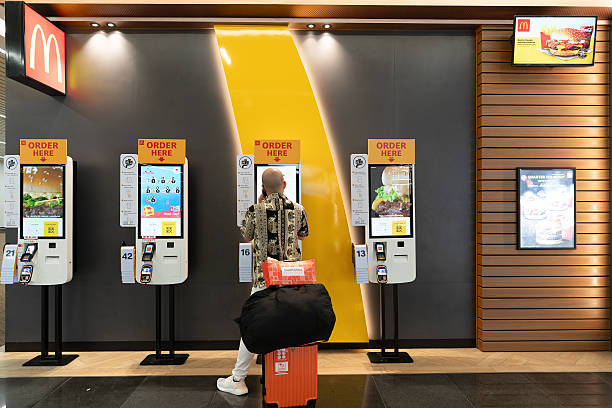
Searching for a generic brand sticker on the back of a McDonald’s machine usually reveals nothing. McDonald’s does not buy off-the-shelf computers; they partner with specialized solution integrators who understand the nuances of QSR operations.
The Primary Manufacturer: Acrelec
The dominant name in this space is Acrelec. Based in France but operating globally, Acrelec manufactures the vast majority of the kiosk enclosures and handles the hardware integration for McDonald’s locations, com mais 80,000 installations across 80 países.
Why does McDonald’s choose Acrelec? The choice goes beyond simple hardware durability. Acrelec was founded by former McDonald’s veterans, Jacques Mangeot and Jalel Souissi. This background gives them a unique insight: they understand the restaurant’s operational flow from the inside out, allowing them to design solutions that align precisely with McDonald’s strict standards and in-store workflows.
Their competitive edge lies in three key areas:
- Operational DNA: Unlike generalist enclosure manufacturers, Acrelec designs kiosks that integrate seamlessly with the kitchen’s throughput. Their hardware focuses on ergonomic efficiency and speed of service, ensuring the technology accelerates rather than bottlenecks the ordering process.
- End-to-End Scalability: McDonald’s requires a partner capable of standardized global rollout. Acrelec provides a consistent “Phygital” experience by blending physical and digital interactions. This ensures brand consistency whether the kiosk is deployed in Paris, Nova Iorque, or Tokyo.
- Modular Lifecycle Management: Acrelec units feature a highly modular architecture. This allows operators to upgrade specific components, such as payment terminals or scanners, without replacing the entire enclosure. This modularity drastically reduces the Total Cost of Ownership (TCO) over the machine’s 5-to-7-year lifespan.
Other Hardware Integrators
While Acrelec is the primary global partner, McDonald’s employs a multi-vendor strategy to serve specific regional markets:
- Pyramid Computer: Dominant in the European market, specifically Germany, Pyramid is known for its “Polytouch” series. This line offers high customizability and sleek aesthetic integration.
- Coates Group: A major player in digital merchandising, particularly active in Australian and Asian markets. Their focus lies in integrating the kiosk into the store’s broader digital signage ecosystem.
Regardless of the specific integrator, the core component defining the user experience is the Projected Capacitive (PCAP) Tela sensível ao toque. This industrial-grade technology is no longer exclusive to global franchises. Em Touchwo, we manufacture our hardware to the exact same benchmarks found in these top-tier deployments.
Por exemplo, our 27-inch Wall Mounting Touch Kiosk, Model GD27C, is engineered with Mohs Class 7 vidro à prova de explosão. This allows it to withstand the physical impacts and scratch risks common in high-traffic QSR environments. Além disso, we integrate high-luminosity 500–700 nits panels and essential peripherals, such as printers and scanners, into a 13mm ultra-slim bezel. This design ensures businesses can access the same operational durability and modularity as a McDonald’s franchise, without the need for a proprietary contract.
The Software and Operating System Developers
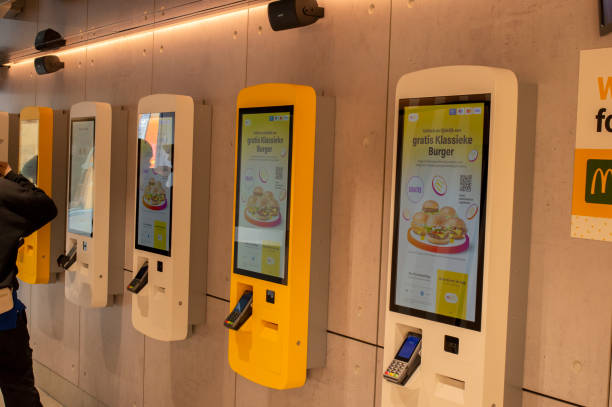
The software infrastructure running these kiosks is often more complex and expensive than the physical machine itself.
The Operating System
Many of these kiosks run on Windows 10 IoT Enterprise. This choice is practical because Windows offers robust driver support for the wide variety of peripherals attached to the system, such as receipt printers, Scanners de código de barras, and card readers.
The Interface and Logic
The user interface and content management are often handled by companies like Stratacache or Evoke Creative. Their systems allow McDonald’s to update prices, menu items, and nutritional information across thousands of screens instantly.
The Strategic Edge: Dynamic Yield
Em 2019, McDonald’s acquired a technology company called Dynamic Yield for roughly $300 million. This acquisition was focused entirely on personalization logic for the McDonald’s self-ordering kiosk.
Dynamic Yield’s technology uses data to adjust the menu in real-time based on specific conditions:
- Weather: It might suggest ice cream on hot days or coffee on cold days.
- Kitchen Load: It can temporarily remove complex items if the kitchen data shows a backlog.
- Order Composition: It can instantly suggest specific add-ons based on what the customer just selected.
This automated “suggestive selling” improves efficiency and consistency, removing the variable of human performance in upselling.
Accessibility and ADA Compliance Features
In the US market, compliance with the Americans with Disabilities Act (ADA) is a critical requirement for kiosk deployment. McDonald’s has faced legal challenges in the past regarding accessibility, leading to significant improvements in their current designs.
The Navigation Keypad
Older kiosk models often feature a square navigation pad with physical buttons and a headphone jack, typically supplied by Storm Interface. This allows visually impaired users to navigate the menu using tactile keys while listening to audio instructions.
Software-Based Compliance
Modern iterations rely heavily on software features to meet regulations. One key feature is Reach Mode, a button that lowers the entire interactive interface to the bottom third of the screen to make it accessible for wheelchair users. Adicionalmente, integrated screen readers provide text-to-speech capabilities for menu options and nutritional data.
Professional Insight: Designing for accessibility is a precise engineering challenge. The touch controller must be sensitive enough to register a light tap, but sophisticated enough to reject false touches, such as a user resting their palm on the screen for balance. Em Touchwo, we also see high demand for anti-glare and anti-fingerprint coatings to assist users with low vision.
How Much Does a McDonald’s Kiosk Cost?
Let’s talk numbers. A fully integrated, dual-sided kiosk unit used by a major chain like McDonald’s is estimated to cost between $50,000 e $60,000.
Why is the cost so high?
The price tag includes more than just the physical materials:
- Brand Premium: Sourcing hardware from Tier-1 global vendors commands a significant price markup.
- Licensing Fees: Recurring costs for proprietary software and POS integration add up quickly.
- Service Contracts: Expensive on-site maintenance agreements are standard.
- Over-Engineering: These units are built to extreme specifications that may exceed the actual needs of a standard retail environment.
For a global corporation, this cost is absorbed over millions of transactions. No entanto, for independent retailers or smaller franchises, the high self-order kiosk price of $60,000 for a single unit is often a deal-breaker.
Why Kiosks Increase Average Check Size
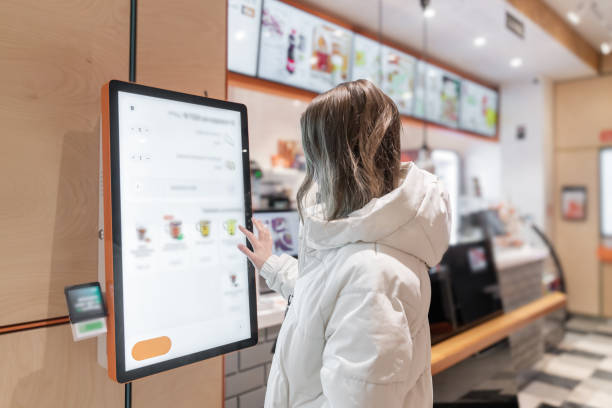
Investing heavily in digital ordering pays off because the math creates a compelling argument. Data consistently shows that quiosques auto-ordenados increase the average check size by 20% para 30%.
The Mechanism of Digital Upselling
There are practical reasons for this revenue increase:
- Reduced Pressure: Customers often feel more comfortable ordering larger meals or extra items without perceived judgement from a cashier.
- Visual Impact: High-quality images of food and drinks trigger impulse purchases more effectively than text on a menu board.
- Consistency: The kiosk never forgets to upsell. It prompts every customer to add a drink or side dish, ensuring maximum revenue per transaction.
This Return on Investment (ROI) means the machine eventually pays for itself, though the payback period on a $60,000 unit is significant.
The good news: You can achieve this 30% revenue boost without the $60,000 price tag. You simply need a reliable touch interface.
Building a Custom Kiosk Solution with Touchwo
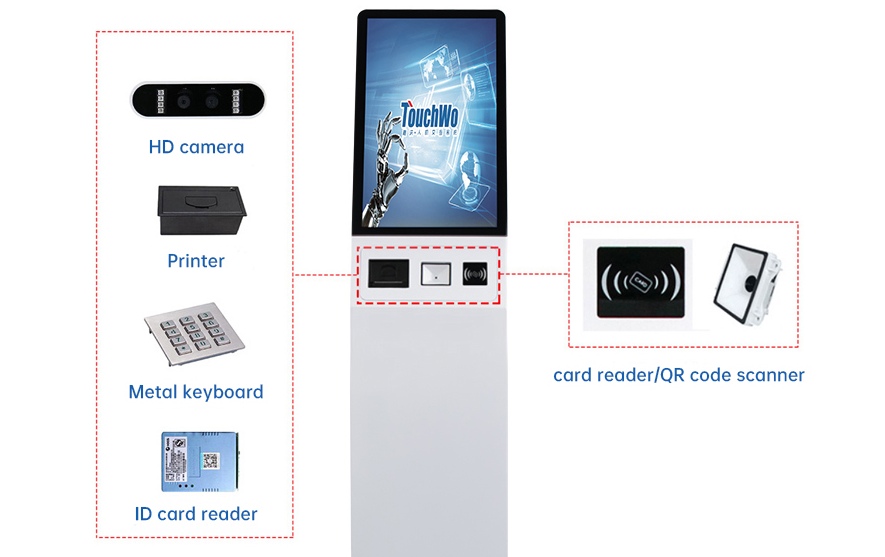
The technology inside a McDonald’s kiosk is modular. That means you can replicate the functionality on a leaner budget by sourcing the hardware directly.
Fundamentally, a self-ordering kiosk is a computer paired with a professional-grade display. By working directly with a manufacturer, you bypass the “brand tax” and gain control over the specifications.
Touchwo operates as a high-tech enterprise with our own R&D centers and manufacturing facilities. Specializing in industrial touch solutions since 2009, we control the entire process from design to assembly.
O “Factory Direct” Vantagem
Smart businesses often adopt the “Open Frame” approach to avoid proprietary markups. You buy the industrial components directly from the factory and integrate them into your own furniture or stands.
As an ISO 9001 certified manufacturer, Touchwo provides the critical hardware foundation for your custom kiosk:
- Professional R&D and Customization (ODM/OEM): Every project has unique constraints. Whether you need a high-brightness screen for a sunny window location, a specific mounting structure, or a custom interface port, our R&D team supports deep personalização. We offer Original Design Manufacturer (ODM) and Original Equipment Manufacturer (OEM) services to tailor the hardware exactly to your project specs.
- Industrial Reliability for 24/7 Operação: Our touch all-in-one PCs and monitors are built with industrial-grade driver boards and aluminum alloy heat-dissipating structures. This ensures they can operate continuously, 7 days a week, 24 horas por dia, without overheating—a critical requirement for the QSR and retail sectors.
- Versatile Product Integration: We offer complete, integrated computing soluções. You can choose from our range of Capacitive Touch All-in-One PCs running Windows or Android, or opt for our Open Frame Touch Monitors if you already have a separate media player. Our products support a wide range of sizes, from compact 10.1-inch units to expansive 55-inch displays suitable for large-format kiosks.
- Global Certification Standards: When building a kiosk for public use, safety and compliance are non-negotiable. Touchwo products carry major international certifications, including CE, FCC, RoHS, and HDMI. This gives you the peace of mind that the core hardware meets rigorous global safety and environmental standards.
Pensamentos finais
McDonald’s has educated the market on using self-ordering kiosks. Now, this technology is accessible to everyone.
You don’t need to be a global franchise to automate your service; you just need the right manufacturing partner. Whether you are a system integrator looking for a steady supply of open-frame monitors or a business owner building a custom solution, Touchwo provides the professional-grade hardware to make it happen.
Are you ready to spec out a custom kiosk solution? Entre em contato conosco hoje to discuss your project requirements.