Zum Inhalt springen

A touch screen sold in one country may need different compliance documents in another. A CE declaration does not replace FCC requirements, and a genuine test report may still fail to cover the model or power supply in your order. For OEMs, Systemintegratoren, kiosk developers, and equipment manufacturers, the key is to match each document to the destination market and the exact product configuration. This guide compares common market requirements and explains what to check before approving a supplier or placing a bulk order.

What Does Touch Screen Certification Cover?
Touch screen compliance usually involves three areas: electrical safety, elektromagnetische Kompatibilität (EMV), and material restrictions. Wireless functions may add radio equipment requirements. The rules that apply depend on the product type, Stromspannung, built-in modules, and destination market.
It is also important to separate product compliance from factory management certification. CE, FCC, CCC, PSE, and RoHS documents relate to a product or a defined product configuration. ISO 9001, ISO 14001, und ISO 45001 describe a company’s management systems. An ISO certificate does not prove that a specific monitor has passed EMC or safety testing, while a product report does not show how a factory controls production.
If your project uses a standalone display, Panel-PC, or kiosk, check the compliance scope for the complete unit and its external power adapter. A Touchscreen-Monitor may have different document needs from a computer or a finished kiosk, even when the display panel is similar.
Touch Screen Certification Requirements by Market
There is no single certificate accepted in every country. Use this table as a starting point, then confirm the rules for the exact product category and configuration with the importer or local compliance specialist.
| Markt | Common mark or requirement | What buyers should confirm |
|---|---|---|
| europäische Union / EEA | CE marking; applicable EMC, RoHS, and electrical safety rules | The EU Declaration of Conformity lists the rules that apply to the product |
| Vereinigte Staaten | FCC-Teil 15 for applicable digital devices | The correct authorization route and the US-based responsible party, where SDoC applies |
| Kanada | ICES-003 for in-scope digital apparatus | Whether the device and external power supply are covered |
| Vereinigtes Königreich | UKCA or accepted CE marking, depending on product rules | The current marking route for Great Britain or Northern Ireland |
| China | CCC for products listed in the compulsory certification catalogue | Whether the exact product category and model are in scope |
| Japan | PSE for specified electrical products; radio approval for applicable wireless functions | Whether the adapter or another component is the regulated item |
| Australia / New Zealand | RCM and applicable electrical or radio requirements | The local responsible supplier and product registration, where required |
| India | BIS registration or certification for listed product categories | Whether the exact display size, equipment type, or adapter is covered |
| Südkorea | KC requirements for applicable products and radio functions | The relevant safety and EMC requirements for the product |
These marks are not interchangeable. Zum Beispiel, PSE does not apply to every touchscreen as a finished product; Japan’s rules cover specified electrical products, and an external AC adapter may be the regulated item. Wireless modules can also trigger separate radio requirements. In Australia and New Zealand, the responsible supplier is a local entity that takes responsibility for in-scope equipment and the use of the RCM.
Key CE, FCC and RoHS Requirements for Touch Screens

CE marking in the European market
CE marking is the manufacturer’s declaration that a product meets the EU rules that apply to it. It is not a general certificate issued by one central EU office. A touch display may need to meet EMC requirements and, when it falls within the voltage scope, the Low Voltage Directive. That scope covers equipment rated from 50 Zu 1,000 V AC or 75 Zu 1,500 V DC. A low-voltage monitor may sit outside that range, while its mains-powered adapter may be within it.
RoHS is a separate EU requirement that restricts certain hazardous substances in electrical and electronic equipment. If radio functions are built in, the Radio Equipment Directive may also apply. Ask for the EU Declaration of Conformity and the supporting reports, and check that they name the product and accessories in your order.
FCC-Teil 15 in the United States
FCC-Teil 15 controls radio-frequency emissions from many digital devices, including touch monitors and kiosk computers. It does not certify electrical safety. Depending on the equipment, the compliance route may be Supplier’s Declaration of Conformity (SDoC) or certification. Where SDoC applies, the compliance information must identify a responsible party in the United States.
Class A and Class B refer to different emission limits. Class B is intended for residential environments and has tighter limits; Class A equipment is generally intended for commercial or industrial environments. Match the class and model on the test report to the product you plan to buy. Changes to the enclosure, Kabel, or internal components can affect EMC performance. For more detail, see our guide to EMI- und ESD-Schutz im industriellen Touchscreen-Design.
RoHS and material records
RoHS focuses on the substances used in the product, not its electrical performance. The EU RoHS rules restrict ten substances in homogeneous materials. The maximum concentration is 0.1% for most restricted substances and 0.01% for cadmium. Ask for a current declaration or material report that identifies the applicable substance list and revision. A generic RoHS statement should not be treated as proof of electrical safety or EMC compliance.
How to Verify Touch Screen Certificates Before Buying
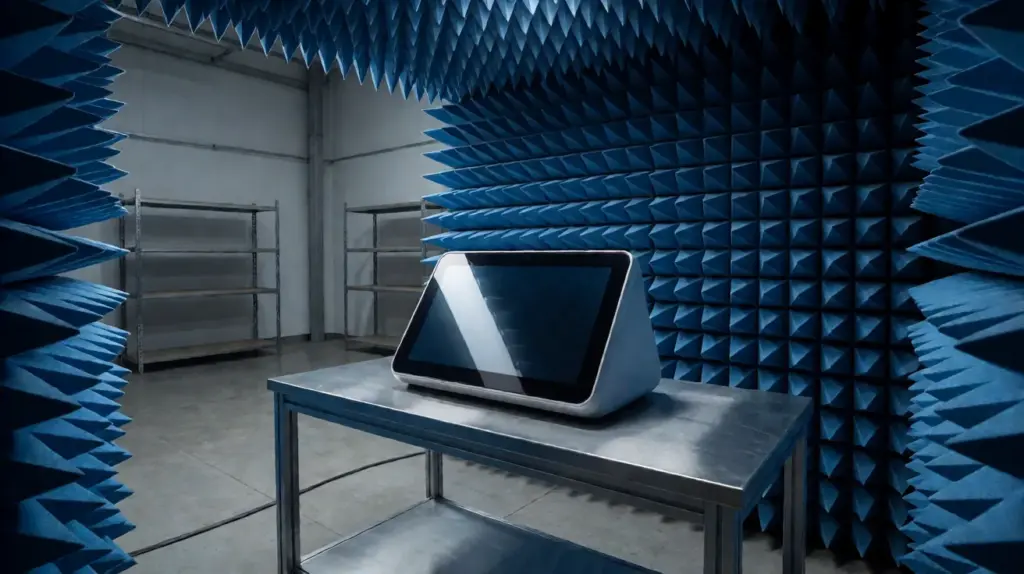
Before paying a deposit, match each compliance claim to the exact product and configuration in your quotation. A real report for a similar model is not enough.
- Modell: Check the full model number, Serie, and suffix on the report against the quotation and product label.
- Konfiguration: Confirm the screen, Regler, Betriebssystem, wireless module, Kabel, and external power adapter match the tested build.
- Standards: Check the standard numbers and versions listed in the report. Make sure they support the market requirement being claimed.
- Test body: Review the laboratory name, report number, and accreditation details where relevant.
- Declaration: For CE, request the EU Declaration of Conformity and check the manufacturer’s legal name and applicable legislation.
- Responsibility: Confirm who holds the technical file, who acts as the local responsible party, and who will provide documents if an authority or customer asks.
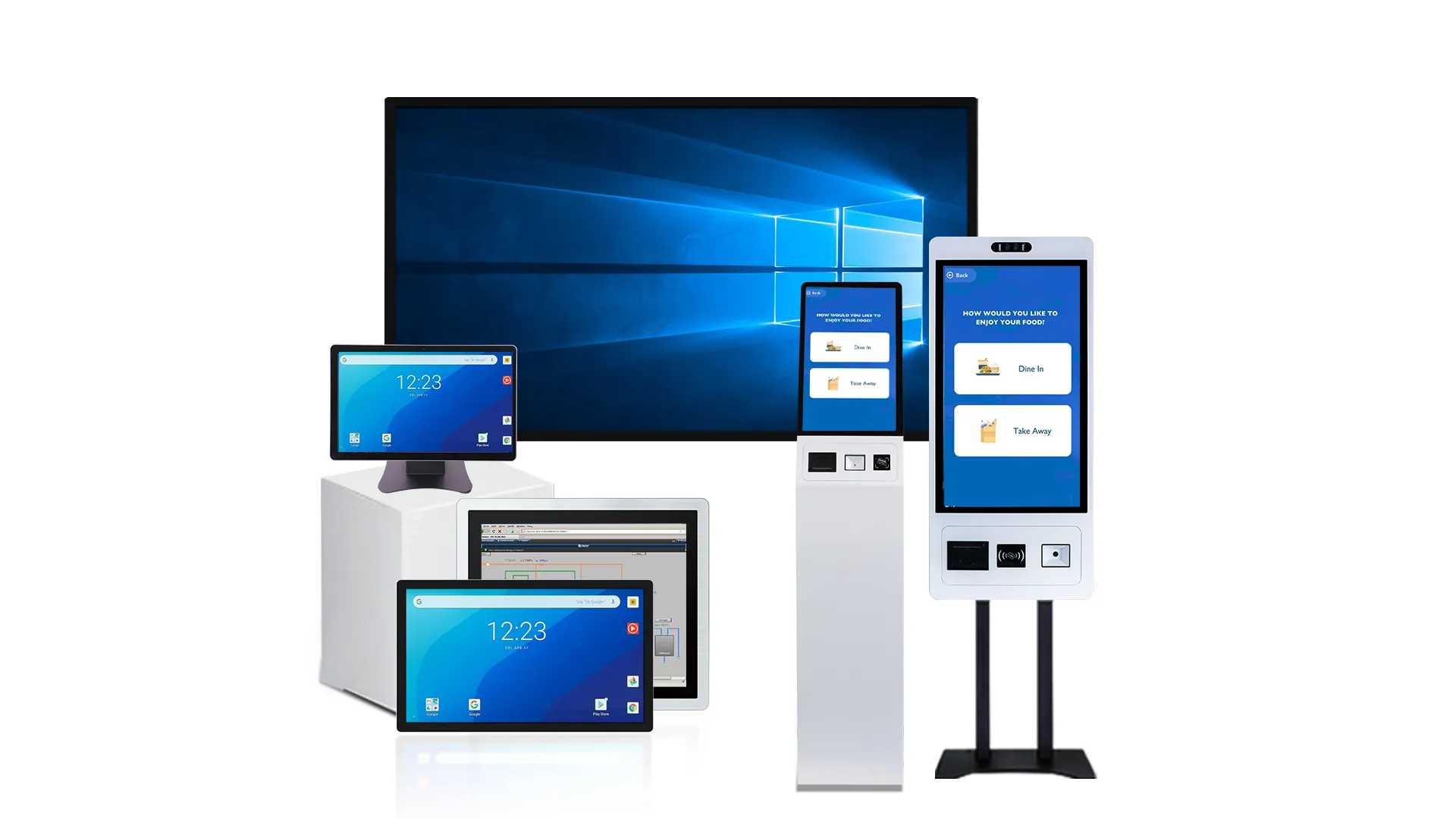
For OEMs and system integrators, record these details in the purchase specification. A change to the power supply, Gehäuse, display size, or wireless module may affect the compliance evidence. When assessing a supplier, review its product documentation alongside its R&D, Testen, and quality-control process. You can also review TouchWo’s touch display and kiosk solutions to understand the product range and project support available.
TouchWo's pre-shipment testing process describes checks carried out before products leave the factory. Ask the sales team to confirm which reports and certificates apply to your exact model, destination, and power configuration. For a customized build, agree on the approved configuration before testing and production.
Häufig gestellte Fragen
Benötigt ein Touch-Monitor sowohl CE als auch FCC??
Ja, wenn das gleiche Design in beide Märkte geliefert wird. Eine Hardwareplattform kann beide Dokumentensätze speichern, Die Erklärungen basieren jedoch auf unterschiedlichen Regeln und unterschiedlichen Prüfberichten. Auch der regionale Energieaufbau verändert sich, Passen Sie also jedes Zertifikat an die Konfiguration an, die Sie tatsächlich kaufen.
Ist RoHS Teil der CE-Kennzeichnung??
Für den europäischen Vertrieb, Die RoHS-Konformität ist Teil des CE-Rahmens und wird von derselben Erklärung abgedeckt. Es handelt sich immer noch um eine eigenständige Richtlinie mit eigener Stoffliste und eigenen Berichten. Andere Märkte wenden ihre eigenen Gefahrstoffvorschriften unter anderen Bezeichnungen an, Daher wird eine europäische Datei nicht automatisch übertragen.
Sind UL oder ETL in den Vereinigten Staaten vorgeschrieben??
Für die meisten gewerblichen und industriellen Geräte, Keine Bundesvorschrift erfordert eine der beiden Auflistungen. Einzelhandelskanäle, Versicherer, und einige Einrichtungsteams verlangen immer noch eines als Kaufbedingung, Dies macht es zu einer Marktzugangsvoraussetzung und nicht zu einer rechtlichen. Fragen Sie Ihren Kunden, welcher Körper auf dem Etikett erscheinen muss.
Was ist der Unterschied zwischen CE und ISO? 9001?
CE ist eine Produktdeklaration: Darin heißt es, dass ein Modell die für es geltenden europäischen Anforderungen erfüllt. ISO 9001 ist ein Werkszertifikat: Es heißt, dass das Unternehmen über ein dokumentiertes Qualitätsmanagementsystem verfügt. Die beiden beantworten unterschiedliche Fragen, und ein Wirtschaftsprüfer verlangt normalerweise beides, weil keines das andere abdeckt.
Wer führt die technische CE-Akte??
Der Hersteller stellt die Erklärung aus und verwahrt die technischen Unterlagen, und diese Akte muss auf Anfrage einer Behörde vorgelegt werden können. Ein EU-Importeur trägt seine eigenen Dokumentationspflichten, Die praktische Antwort hängt also davon ab, wer das Produkt auf diesem Markt platziert hat. Schreiben Sie die Verpflichtung vor der ersten Lieferung in den Liefervertrag.
Letzte Gedanken
Start with the destination market, then confirm the product category, model number, and power configuration. Ask for the relevant declaration and test reports before approving the order. This simple check helps OEMs, integrators, and equipment manufacturers avoid delays caused by documents that cover a different model or build.
If you are sourcing a standard or customized touch display, share the destination country, model requirements, and power input with the supplier. Für OEM-Projekte, TouchWo’s customization service can help align the product configuration with your application before the order is confirmed.