Capacitieve touchscreens can operate reliably through thick glass, but achieving consistent performance requires more than simply increasing touch sensitivity. As cover glass becomes thicker, the electrical signal between the user’s finger and the touch sensor becomes weaker, making controller selection, sensor design, optische binding, and firmware tuning increasingly important.
This guide explains how projected capacitive (PCAP) technology works through thick glass, what limits touch performance as glass thickness increases, and the engineering strategies used to maintain fast, accurate touch response in industrial and OEM applications.
How Capacitive Touch Works Through Cover Glass
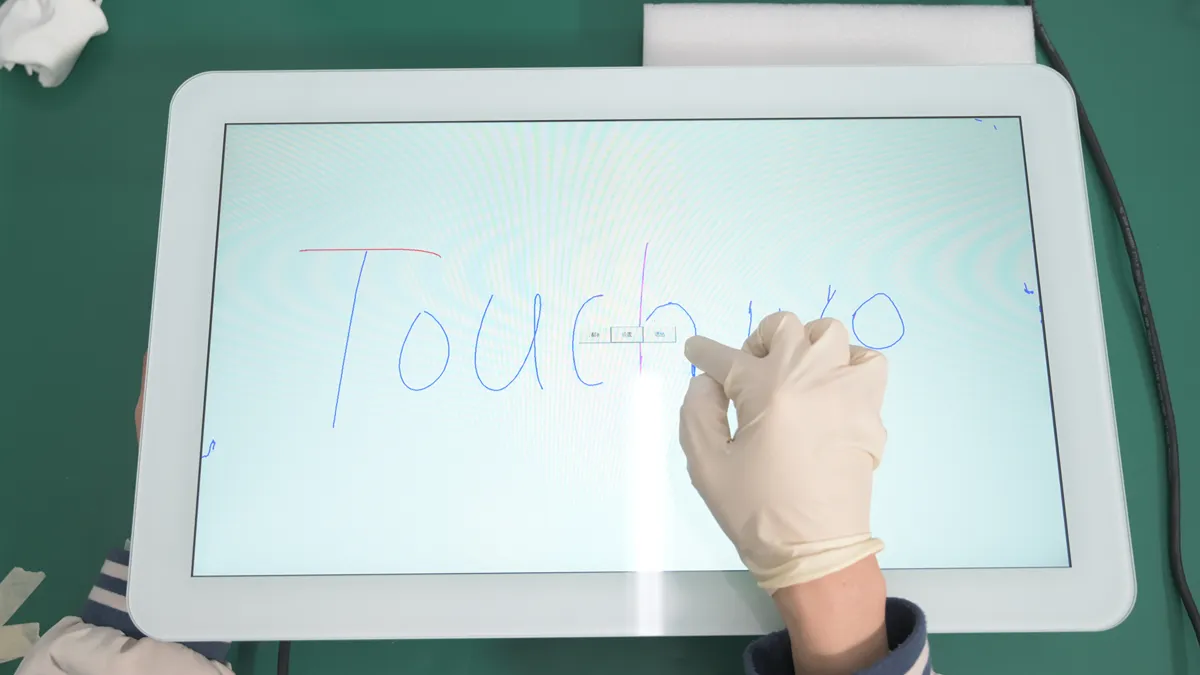
Capacitieve aanraking operates through glass by projecting an electric field from a sensor grid. A controller detects the tiny electrical changes caused when a finger disturbs this field.
The Principle of Projected Capacitive Sensing
Geprojecteerd capacitief (PCAP) technology doesn’t rely on physical pressure. In plaats van, it detects the interaction between an electric field and a conductive object, like your finger. This allows it to function perfectly through rigid, non-flexible materials such as glass.
- A grid of transparent X and Y electrodes, typically made of Indium Tin Oxide (DIT), creates a matrix where mutual capacitance can be measured at each intersection.
- When a finger approaches the glass surface, it couples with the electric field and causes a very small change in capacitance at the nearest nodes in the grid.
- A touch controller integrated circuit (IC) continuously scans this matrix, measuring these tiny capacitance changes to identify the precise coordinates of single or multiple touches.
Propagating the Electric Field Through Glass
For the system to work, the sensor’s electric field must be strong enough to extend through the cover glass, which acts as a dielectric insulator, to reach the user’s finger. The quality of this connection is critical.
- As the glass gets thicker, the capacitive coupling between the finger and the sensor weakens, which reduces the signal strength the controller has to work with.
- Reliable operation depends on generating a sufficiently strong electric field and maintaining a high signal-to-noise ratio (SNR) to distinguish touches from background electrical noise.
- Any air gaps between the sensor and the cover glass will severely disrupt the electric field, so direct optical bonding with materials like OCA or OCR is the preferred method for optimal performance.
Controller and Sensor Design Requirements
Making capacitive touch work through thick glass isn’t an accident; it requires specific engineering choices in both the electronics and the physical sensor layout.
- The touch controller IC needs a high drive capability to project a powerful electric field that can cross the entire thickness of the dielectric layer.
- A high-sensitivity, low-noise analog front-end is essential for reliably measuring the faint capacitance changes that a touch produces through the glass.
- Sensor electrodes can be designed with larger surface areas or optimized patterns specifically to maximize the capacitive coupling effect through thicker materials.
- Advanced signal processing algorithms are used to filter out electrical noise, track slow changes from the environment, and accurately tell the difference between a true touch and interference.
Performance Capabilities and Limitations
Well-engineered systems can deliver a responsive and accurate touch experience even with significant glass thickness. The key is balancing durability with electronic sensitivity.
- Modern PCAP systems maintain fast, accurate multi-touch and gesture support through glass that is several millimeters thick.
- Specialized controller tuning can also enable advanced features like operation with gloves and water rejection, which are critical for industrial and outdoor applications.
- While many standard modules support glass up to 2 mm dik, high-performance designs can operate reliably through 5 mm and even up to 10 mm of glass.
- The primary trade-off is straightforward: increasing glass thickness for more durability demands more powerful electronics and meticulous system tuning to maintain sensitivity and stability.
What Limits Touch Performance When Glass Gets Thicker
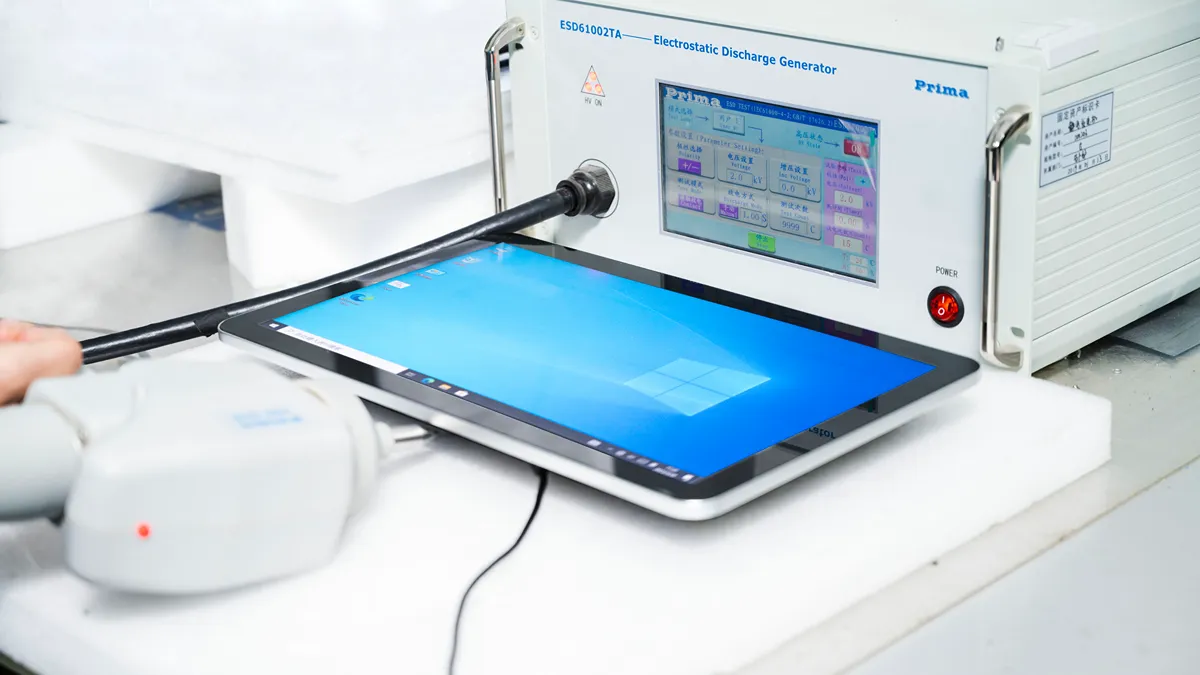
The core issue is simple physics: greater distance between a finger and the sensor weakens the electrical signal, degrading the signal-to-noise ratio and making reliable touch detection harder.
Reduced Electrical Coupling and Lower Signal-to-Noise Ratio (SNR)
The main problem is the increased physical distance between the user’s finger and the sensor electrodes. This extra space weakens the capacitive coupling, which is the electrical effect the system measures. A weaker coupling means the change in capacitance (ΔC) for each touch is smaller, making the signal much harder for the controller to detect against background electrical noise.
As the touch signal shrinks while the noise floor remains constant, the overall signal-to-noise ratio (SNR) drops significantly. This directly degrades performance. With more distance, the electric field lines also spread out, which reduces positional accuracy and makes it difficult for the system to distinguish between two close touch points.
System-Level Electrical Constraints
The touch controller hardware has its own limitations. Every controller has a finite resolution, and if the ΔC from a touch is too small, it can become indistinguishable from the controller’s own internal noise. The system simply can’t “hear” the touch over its own hum.
Larger and thicker glass also increases parasitic capacitance throughout the sensor stack. This acts like electrical dead weight, slowing down the sensor’s response time and potentially limiting the maximum touch report rate. To compensate for a weak signal, controllers often have to use higher gain or longer measurement times, which in turn increases power consumption and introduces latency.
Increased Susceptibility to Environmental Factors
A system with an inherently low SNR is far more vulnerable to external electromagnetic interference (EMI). Noise from nearby motors, voedingen, or even fluorescent lighting can easily disrupt a weak touch signal. Performance with gloves or in the presence of water also degrades more sharply, as these conditions further reduce the already faint signal.
This problem often compounds itself. Thicker glass is typically chosen for products used in harsh industrial or outdoor environments—the very places where EMI and contaminants like water are most common.
Mechanical and Optical Trade-Offs
There is a fundamental trade-off between mechanical durability and touch sensitivity. As you increase one, the other almost always decreases. Thicker glass is tougher, but it makes touch detection more difficult. Optically, thicker glass also increases the physical gap between the touch surface and the display’s pixels. This creates a parallax effect, where the point you touch feels disconnected from the visual element on the screen, reducing perceived accuracy.
One way to manage this trade-off is by using chemically strengthened glass. It can provide the required durability at a reduced thickness compared to standard glass, which helps mitigate some of the loss in touch performance.
Ontvang op maat gemaakte industriële touchscreens, Shipped Fast.
Design Factors That Improve Sensitivity Through Thick Glass
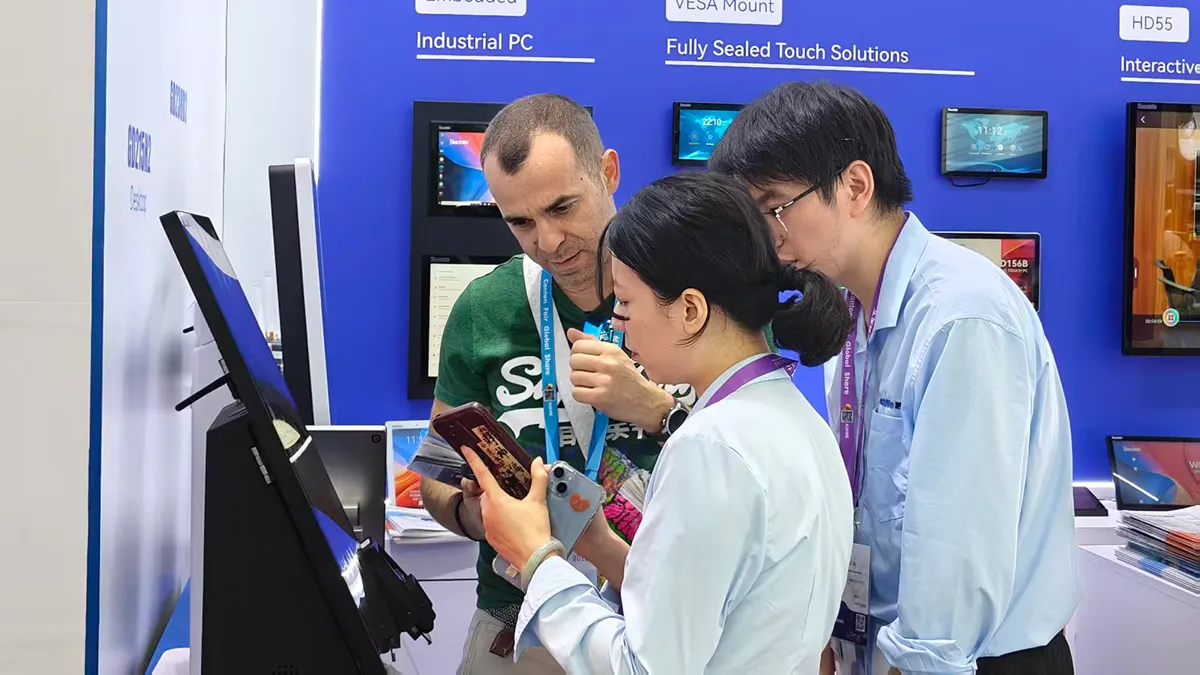
Improving touch sensitivity through thick glass requires a systems approach. Optimizing the cover glass, sensor geometry, controller tuning, and final assembly are all critical to maintaining a strong signal.
| Design Factor | Key Considerations to Boost Signal Strength |
|---|---|
| Cover Glass Properties and Bonding |
|
| Sensor Electrode Geometry |
|
| Controller Tuning and Signal Integrity |
|
| Operational and Environmental Factors |
|
Trade-Offs Between Durability, Helderheid, and Touch Response
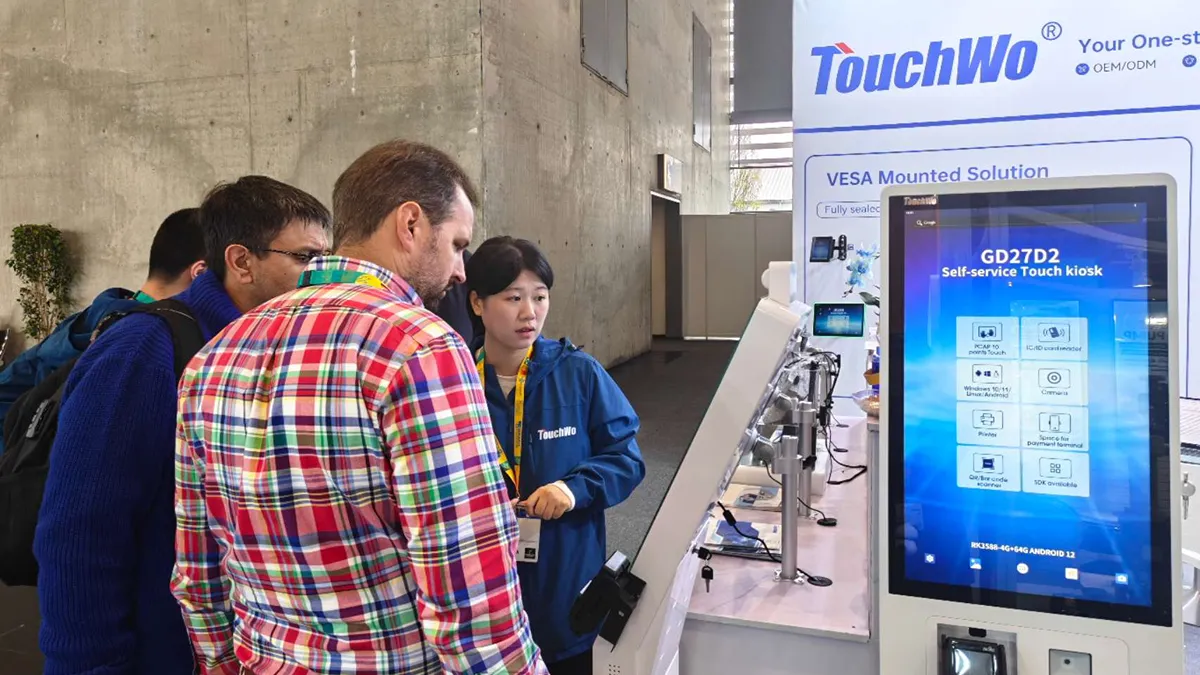
Increasing glass thickness improves durability but weakens touch response and optical clarity. The right balance depends entirely on the application’s non-negotiable requirements, not a one-size-fits-all solution.
Impact of Glass Thickness on Durability
Thicker glass provides higher impact resistance, which is fundamental for achieving high IK ratings like IK09 or IK10 in public kiosks or harsh industrial settings. The added thickness also improves scratch resistance and overall stiffness, reducing the kind of flex that can cause false touches or damage the underlying display. But durability isn’t just about thickness; it’s a system-level property that also depends on the type of glass used (tempered vs. chemically strengthened), the edge design, and how the entire assembly is mechanically mounted.
Impact of Glass Thickness on Touch Response
As glass gets thicker, the distance between a finger and the touch sensor increases. This weakens the capacitive signal and lowers the signal-to-noise ratio (SNR). This signal degradation is what leads to real-world problems like missed touches, reduced multi-touch accuracy, or sluggish performance. To maintain a responsive touch experience through glass thicker than 2 mm, you can’t rely on standard hardware. It requires advanced projected capacitive (PCAP) controleurs, aggressive firmware tuning, and optimized sensor patterns to compensate for the weaker signal.
Impact of Glass Thickness on Optical Clarity
Thicker glass can slightly reduce light transmittance and increase the chance of internal reflections, which can appear as ghosting on the display. To maintain good readability, especially in outdoor or brightly lit environments, thicker glass stacks almost always require anti-reflection (AR) or anti-glare (AG) coatings. This is also where optical bonding between the glass and the display becomes much more critical. It eliminates reflective air gaps, which significantly improves contrast and sunlight readability.
Balancing the Trade-Offs for Specific Applications
There is no single “best” dikte. The optimal choice is a direct function of the product’s environment and primary use case.
- High-Durability Focus (Openbare kiosken): These applications prioritize thick (2–3 mm), strengthened glass for maximum impact resistance. The design accepts the need for high-performance touch controllers to compensate for the inherently lower touch sensitivity.
- High-Clarity Focus (Medical Displays): Hier, image quality and responsiveness are paramount. Thinner glass (0.7–1.5 mm) combined with optical bonding and AR coatings is used to maximize visual performance, trading off some raw impact strength.
- Evenwichtig ontwerp (Industrial Panels): A common compromise for general industrial use involves 1.5–2 mm glass. This offers good durability for most factory environments while maintaining acceptable touch and optical performance with standard industrial-grade controllers.
When Thick-Glass Touch Designs Make Sense for OEM Projects
Thick-glass touchscreens are a strategic choice for OEMs when durability and safety are non-negotiable, justifying the cost in harsh industrial, public, and safety-critical applications.
Deciding to use a thick glass cover for a projected capacitive (PCAP) touch interface isn’t just about touch performance; it’s a decision driven by the operating environment and total lifecycle cost. For original equipment manufacturers (OEMs), specifying glass that’s 3mm or thicker is a move reserved for products that must survive conditions far beyond a typical consumer device. These applications demand a level of physical robustness where a standard, thinner screen would quickly fail.
For High-Impact and Vandal-Prone Environments
The most straightforward case for thick glass is physical protection. When a device is placed in an uncontrolled or demanding environment, the risk of damage from impacts—both accidental and intentional—skyrockets. Using chemically strengthened or thermally tempered glass of 3mm to 6mm or more provides the durability needed to achieve high impact ratings like IK09 or IK10, ensuring the equipment remains operational.
- Industrial HMIs exposed to dropped tools, accidental impacts from carts, and the general abuse of a factory floor.
- Public-facing kiosks, ticketing machines, and EV chargers that must withstand vandalism and constant use.
- Transportation systems where displays in trains, buses, or marine vessels must endure abuse from passengers or impacts from luggage.
- Applications where the cost of downtime or a field service call to replace a cracked screen is unacceptably high.
In Safety-Critical and Hygienic Applications
In some industries, the consequences of a screen breaking go beyond simple equipment failure. Safety and hygiene requirements often dictate the use of a thicker, more resilient front surface. Een naadloos, durable glass front eliminates crevices where contaminants can hide and provides a barrier that can withstand harsh cleaning protocols that would degrade plastics or thinner materials.
- Medical, voedsel, or pharmaceutical equipment where glass fragments from a break must not contaminate products or processes.
- Public terminals where the liability from potential user injury from shattered glass is a primary business concern.
- Systems requiring frequent cleaning with harsh chemical disinfectants that would degrade thinner glass or plastic overlays.
- Cleanroom interfaces where a completely sealed, non-porous glass surface is essential for sterilization.
When Long-Term Reliability Justifies the Upfront Cost
Thick-glass designs carry a higher bill-of-materials cost and require more engineering effort for controller tuning. This investment makes sense when the product is designed for a long service life, especially in locations where maintenance is difficult or expensive. The higher initial cost is offset by reduced field failures, lower warranty claims, and a more robust product platform.
- Products designed for a 10+ year service life in harsh outdoor or industrial conditions.
- Remote or hard-to-service installations like mining equipment, marine electronics, or agricultural machinery, where a screen replacement is cost-prohibitive.
- OEMs who can standardize on a single rugged HMI platform to simplify design, testen, and supply chain across multiple product lines.
- Devices operating in extreme temperatures where thicker glass offers greater stability against thermal stress cracking.
How Touchwo Supports Custom Touch-Structure Development
We develop custom touch assemblies by systematically engineering the cover glass, sensor, controller, and housing to meet specific industrial and environmental demands for durability and performance.
Developing a custom projected capacitive (PCAP) touch solution for thick-glass applications is an engineering process, not just a component selection. The entire stack—from the outer glass to the internal firmware—must work as a single system. Our process focuses on aligning each layer to the final application’s real-world challenges.
Defining Cover Glass and Environmental Needs
The process starts by defining the operational environment. This dictates the physical properties of the front panel. We work with clients to lock down the specific durability and sealing requirements that drive the rest of the design.
- We establish the necessary cover glass thickness and material (bijv., tempered or chemically strengthened) based on the target environment, whether it’s a factory floor or a public-facing kiosk.
- The required IP rating, such as surface IP65 for waterproof and dustproof operation, is determined to guide the mechanical sealing strategy.
- Impact resistance needs are specified to ensure the final assembly can withstand accidental contact, druppels, or potential vandalism in its intended application.
Selecting Sensor Structure and Bonding Method
With the physical requirements set, we engineer the core sensing components. The sensor’s construction must be robust enough for the environment and sensitive enough to function through the specified cover glass.
- We select a PCAP sensor construction, like a rigid Glass/Glass (GG) structure, to match the durability needs of industrial use.
- The sensor’s electrode pattern and density are matched to the glass thickness to ensure the electric field properly projects to the surface and maintains touch sensitivity.
- Optical bonding is utilized to laminate the layers into a solid stack. This eliminates the air gap that can weaken the touch signal and degrade screen readability.
Integrating and Tuning the Touch Controller
The touch controller IC and its firmware are the brains of the system. For thick-glass applications, selecting and tuning the right controller is critical for performance. It must be powerful enough to drive a signal through the glass and smart enough to interpret the response accurately.
- A touch controller IC is chosen specifically for its ability to handle signals through thicker dielectric materials without losing performance.
- We tune the controller’s firmware to optimize touch sensitivity, nauwkeurigheid, and response time for the final, fully assembled product.
- The system is calibrated for specific operational needs, such as reliable glove-touch functionality or ensuring electromagnetic compatibility (EMI) in noisy factory environments.
Customizing Mechanical Housings and Sealing
The final step is to create the physical enclosure that protects the electronics and ensures the unit can be integrated into the client’s equipment. Our capabilities extend to creating fully custom mechanical designs.
- We use our private mold design capabilities to develop custom frames and enclosures that match the exact form factor required.
- Advanced frame-pasting and sealing technologies are applied to produce a pure flat, dun, and robust assembly that meets industrial standards.
- The final product is validated to ensure the complete assembly meets the specified requirements for durability and environmental protection.
Veelgestelde vragen
How thick can glass be for a capacitive touch screen?
Standard consumer screens typically use glass from 0.7 mm to 2 mm dik. For industrial applications requiring more durability, thicknesses of 4 mm to 6 mm are common but require specialized firmware. In highly demanding environments, custom-engineered systems can achieve reliable touch detection through 7 mm to 15 mm of glass by using optimized sensors and controllers.
Can capacitive touch work through tempered glass?
Ja. Tempered glass is a standard and preferred material for capacitive touch screen overlays due to its high durability and safety profile. Sinds capacitive technology works by projecting an electric field through non-conductive materials, it functions effectively through tempered glass as long as the controller and sensor are tuned for the specific thickness.
What key factors affect touch sensitivity through glass?
The main factors include glass thickness, the sensor’s electrode geometry, controller sensitivity settings, parasitic capacitance from nearby components, and the electrical grounding path of the user. Optimizing all these elements is crucial for reliable performance, especially when designing for thick glass.
Does optical bonding improve touch performance through thick glass?
Optical bonding helps indirectly. While it doesn’t increase the raw capacitive signal, it improves the system’s overall robustness by eliminating the air gap between the glass and the display. This prevents internal condensation, increases mechanical stability, and enhances optical clarity, making the use of thick glass in industrial or outdoor settings more practical and reliable.
When should an OEM avoid a thick-glass design?
OEMs should avoid thick-glass designs when the application requires high-precision input (like from a passive stylus), must operate in extremely noisy electrical environments, or has strict low-power requirements for battery life. The increased controller power and sensitivity needed for thick glass can conflict with these goals. If cost, gewicht, or optical parallax are also major constraints, a thinner glass solution is generally preferable.
Laatste gedachten
Designing a capacitive touch screen for thick glass is always a balance between durability, aanraakgevoeligheid, and optical performance. While thicker cover glass improves impact resistance and long-term reliability, maintaining a responsive user experience requires careful optimization of the touch sensor, controller, firmware, and optical bonding process.
For OEM projects, the best solution is rarely defined by glass thickness alone. In plaats van, it comes from designing the entire touch system around the application’s operating environment, durability requirements, and user interaction needs. A properly engineered PCAP solution can deliver reliable touch performance even under demanding industrial and outdoor conditions.