A white label touch monitor leaves the factory carrying your name instead of the maker’s. The bezel shows your logo, the carton shows your artwork, and the paperwork lists your company. The design underneath stays the manufacturer’s, and that is what keeps the change routine rather than a development project.
This guide covers the four surfaces you can brand on white label touch monitors. It lists the files a supplier needs before quoting, and the checks that prove the branding survives a production run. Read it as a briefing document you can paste into an inquiry, whether the build is a monitor, A panel PC, or a kiosk display.
What a White Label Build Changes
White labeling replaces the identity on a product that already exists. The screen, the housing, the board, and the firmware come from the manufacturer’s catalogue. What changes is what a buyer sees and touches, from the print on the frame to the box in the receiving bay.
That boundary matters when you compare quotes. A supplier who brands a standard platform can usually hold the hardware price and quote branding as a small add-on line. A supplier who treats the same request as a design project will attach engineering time to it, and the difference shows up before the first unit ships.
| Branding surface | What you send | What the factory changes |
|---|---|---|
| Housing colour and finish | A colour code and a finish note | Painted parts or a stocked colour variant |
| Logo on the bezel | Vector artwork and a position drawing | Printed, engraved, or applied marking |
| Boot screen and interface | Graphic files and a launcher specification | Loaded image or firmware graphic |
| Carton and documents | Print artwork or a dieline, manual files | Printed box, inserts, and quick-start sheet |
Each surface has its own setup step, and a quote that bundles them into one line hides which of them drives the cost. Ask for four separate lines, then decide whether you need all four on the first order. Many fleets start with the bezel logo and the carton, and leave the software surfaces for a later revision.
White labeling brands an existing product. Custom engineering changes the product itself. Ask which one a quote describes before you compare prices.
Colour and Logo on the Housing
Colour is the shallowest change available. TouchWo lists colour and logo as two of the ten dimensions on its customization page, alongside appearance, configuratie, interface, maat, module, materiaal, scherm, and installation method. The same page presents the work as a branded build reached through its published eight-step flow rather than a research project. Read that list as the supplier’s own framing of the work, then ask which of the ten dimensions your request actually touches.
Ask for a physical colour sample and sign it. A code on paper is a description, while a painted part you keep is a reference for every later batch. Then ask the blunt question about repeat orders: how does the factory hold a colour across orders placed months apart, and what happens when a paint lot drifts.
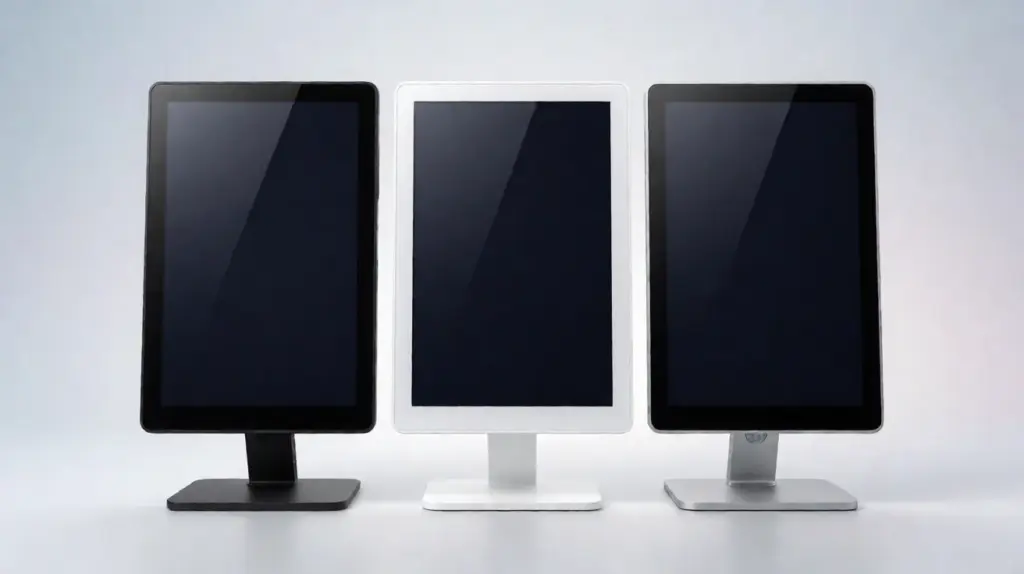
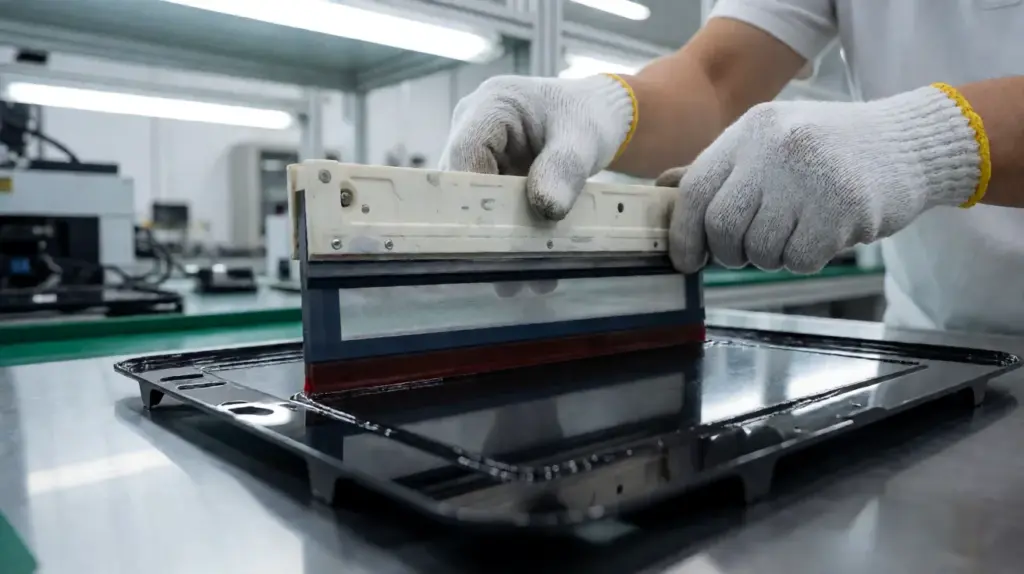
The logo method decides durability and change cost. Silk screening puts ink directly on the frame and suits most volumes. Laser engraving removes material instead of adding it, so the mark survives cleaning and abrasion on metal housings. An applied badge or label is the cheapest to reissue when your brand identity changes. Ask which method the quoted price assumes, because a badge substituted for a print at production is a visible change to your customer.
Whatever the method, the file package is the same. Send vector artwork, a colour reference for the ink, and a position drawing that gives the logo size and its distance from a bezel edge. A raster image copied from your website will not scale cleanly onto a frame, and a logo placed by eye on a sample will drift across a batch.
Boot Screen, Interface, and System Strings
Software branding is where a white label build either finishes or quietly fails. Check the power-on graphic, the launcher or desktop the unit settles into, the device name shown in settings, the about screen, and any preloaded application. A manufacturer logo in one of those places reaches your customer without your knowledge.
Write the requirement as an exclusion list rather than a request. State that no maker branding may appear on the outer carton, the boot graphic, the launcher, the system strings, or the labels inside the housing. Verify each of those five items on a sample unit before a batch is released. Ask which build of the loaded image the sample carried, because a demo image and a production image are not the same file.
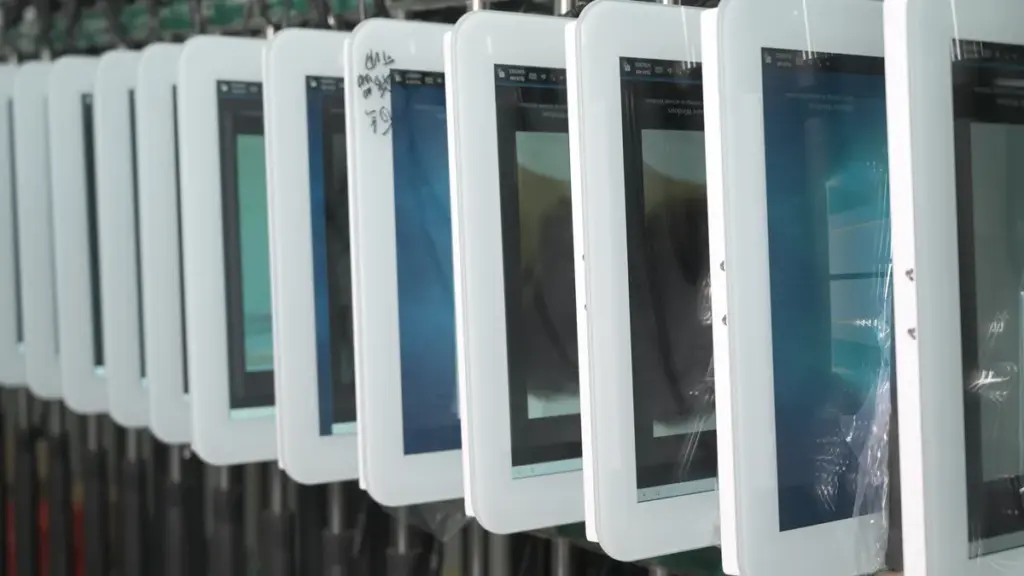
Factory checks interact with that requirement. TouchWo's expertise page publishes ten tests before delivery and a 48 hour powered functionality run before packing, so units are switched on during quality control. Confirm that the branded image loaded at that stage is the production image, not a factory default that never changes. Ask for the test record that names the loaded image version, so the paperwork matches the unit in front of you.
Cartons, Documents, and Import Marking
Packaging is the first physical contact your customer has with the product. Options run from a plain neutral carton to a printed box with branded inserts. De monitor category page lists a tailor-made package and logo branding among its basic brand options, next to colour and material choices. Printed board carries its own minimum quantity and lead time, so quote it with the hardware instead of adding it at the packing stage. Manuals and quick-start sheets follow the same logic, since a generic leaflet with another company’s contact details arrives inside your box.
One marking is not a branding choice. 19 CFR 134.11 requires that articles of foreign origin imported into the United States be marked to show their country of origin to the ultimate purchaser. The marking must be conspicuous, legible, and permanent. Your own logo does not remove that duty, so agree in writing whose carton label and which product sticker carries it.
White Label, OEM, ODM, and Reselling
Suppliers use these four words loosely, and the same request can sit in a different tier at each one. The table below gives the working definition this guide applies, so you can place your own request before you ask for a price. A supplier who prices the tiers together is usually describing engineering work you did not ask for.
| Model | Who owns the design | What carries your brand |
|---|---|---|
| Reselling | The manufacturer | Nothing, units arrive with the maker’s name |
| White label | The manufacturer | Logo, colour, packaging, loaded image |
| OEM | Your specification on their platform | Everything, plus configuration changes |
| ODM | A design developed for you | Everything, including structure |
The line between white label and OEM is depth rather than kind. Branding a standard platform keeps the hardware price intact, while changing interfaces, materialen, or structure moves the request into engineering. TouchWo states flexible OEM and ODM services at a one-piece MOQ on its about page. The same page lists five in-house supply chains and a size range of 5 naar 110 inches across 26 sizes.
Read those as the supplier’s own published claims and confirm the part that matters to your request. For pricing behaviour across volumes, the breakdown of custom touchscreen OEM pricing covers NRE, tooling, and unit cost line by line. For a single branded pilot, one-piece MOQ custom touch hardware explains what one unit does and does not settle.
A brand is a promise about batch number two, not batch number one. Write the consistency requirement before the sample, not after it.
How to Brief a White Label Supplier
A complete first briefing shortens the quotation and prevents the commonest rework. Send the following in one message, then ask the supplier to price each branding line separately. Vague briefs produce blended quotes, and a blended quote cannot be compared between two suppliers.
- Vector logo artwork with usage rules and a minimum clear-space note.
- A colour reference for housing and ink, plus the finish you expect.
- A position drawing giving logo size and distance from a bezel edge.
- Boot graphic and launcher files, with the target operating system named.
- Carton artwork or dieline, plus the manual and quick-start files.
- Quantities per order and per year, since printing minimums follow volume.
- A written no-maker-branding clause covering box, scherm, labels, and strings.
Then set the acceptance test before the sample ships. A monitor product page such as the 15.6 inch industrial touch monitor shows the kind of specification sheet a review starts from. Your branding requirements belong in that same document, next to the electrical and mechanical detail. Ask for a signed colour sample, a retained first-article unit, and a fixed artwork revision number recorded on the purchase order.
Those three artefacts do most of the work on repeat orders. When batch five arrives, compare it against the retained unit and the signed panel rather than against a memory of the first sample. If you deploy a fleet, keep a small stock of spare printed parts so a service repair does not put an unbranded frame into a branded installation. Photograph the retained unit from the same angle each time, and file the images with the order number.
Veelgestelde vragen
What is the difference between white label and OEM?
White label puts your brand on a platform the manufacturer already designs and builds. OEM applies your specification to that platform, changing configuration, interfaces, or materials. The first is a branding order, the second an engineering order, and suppliers price them on different lines.
Can white label units ship with no trace of the maker’s brand?
Ask for it as a written exclusion list covering carton, boot graphic, launcher, system strings, and internal labels. Then verify each item on one sample before a batch is released. A verbal promise usually survives the hardware and misses the software.
What files does a supplier need to quote logo branding?
Vector artwork, a colour reference for the ink or engraving, and a position drawing that fixes size and distance from a bezel edge. Add the target model and your annual quantity, since those two decide which application method is practical. A screenshot from your website is not a usable source file.
Does white label branding change the warranty?
Do not assume either answer, because the terms depend on what the supplier writes into your order. Ask whether a branded unit carries the same coverage as the same model sold under the maker’s name, and who handles a return. Get the answer in the purchase agreement, next to the spare parts clause.
Is a country of origin mark still needed on my own branded cartons?
For United States imports, marking rules apply to the article or its container rather than to a brand name. Your logo does not replace the origin statement an ultimate purchaser must be able to read. Agree which label carries it and who prints it before the first carton run.
Laatste gedachten
White labeling is the cheapest brand you can buy, and it fails in predictable places. A logo placed without a position drawing drifts across a batch. A boot graphic left at a factory default reaches a customer with someone else’s name. A printed carton quoted after the hardware arrives late and unbranded.
Each failure has the same cure. Name the surfaces you want changed, send the files that describe them exactly, and hold one signed unit as the reference for every order after it. A supplier who can quote four branding lines separately and show you a retained sample is describing a routine build. One who answers with a single blended price is describing something else.