Send a supplier one line asking for a 21.5 inch touch monitor and a number comes back. That number rests on assumptions the factory chose, not the ones you hold. Send the same request as a structured brief and the reply becomes a quotation you can compare, يكلف, and hold someone to. The gap between those two answers is the subject of every OEM touchscreen quote.
This guide covers the inputs a custom display brief must carry, what each one changes in the price, and what a factory does with the file once it lands. It is written for buyers preparing an OEM touchscreen quote request for monitors, أجهزة الكمبيوتر لوحة, and integrated display hardware. Every TouchWo statement here points at a page on this site that you can open yourself.

A quotation is a promise about one configuration. Every line you leave out is a line the supplier writes for you.
Quote Quality Follows Brief Quality
A price means nothing without the specification behind it. Where a brief leaves a gap, the supplier fills it, and the fill rarely favors the buyer. Under-quoting loses the factory money on a build it cannot reopen, so unknown details drift toward safer components and higher margins. That is the mechanism behind padded numbers, and it is not dishonesty.
The same gaps wreck the comparison stage. Three suppliers answering a vague request price three different products, and the rows that look comparable on a spreadsheet are not. Buyers usually find that out late, when one vendor asks for a change order on a feature another included as standard. A complete brief removes the variable first, and the anatomy of the resulting numbers is covered in the guide to custom touchscreen OEM pricing.
Seven input groups cover what an OEM touchscreen quote needs. None of them is exotic, and a buyer who fills all seven can compare replies line for line. Each group closes a place where two different builds can carry one price.
The brief doubles as the change control baseline. When someone later asks for different brightness or an extra port, the file shows which quotation line that request moves. The answer arrives as a priced delta rather than a fresh negotiation, and the project keeps one specification instead of three.
| Input group | What it decides | What to write |
|---|---|---|
| Display and touch | Panel and touch stack, the largest single cost line | مقاس, دقة, brightness target, touch type, cover glass |
| بيئة | Component grade, ختم, and the testing scope | Indoor or outdoor, temperature extremes, dust or washdown |
| Mounting and mechanics | الأدوات, enclosure work, and finishing | Fixing method, cutout drawing, material, لون, شعار |
| Computing | Board, license, power supply, and port count | Operating system, processor class, ذاكرة, الموانئ, input voltage |
| Quantities | Unit price and the platform a supplier recommends | Pilot units, annual estimate, reorder rhythm |
| Terms | Where the quoted price stops and freight starts | Trade term with a named place, packaging, delivery window |
| سوق | Certification scope and the regional power build | Destination country, certificates required, voltage and plug |
Display and Touch Facts to Specify
Panel selection carries more of the unit price than any other decision. State the size, the native resolution, the aspect ratio, and the brightness the site actually needs. Then say whether an A grade panel is required or a mixed grade is acceptable. A brightness figure chosen for a windowless factory floor is money that never becomes a working display. ال شاشات شاشة اللمس الصناعية range on this site lists panel figures model by model, which is why the size and brightness lines belong in the brief before any quote.
Brightness deserves a site figure rather than a preference. A screen under direct sunlight needs a different backlight and a different glass treatment from the same panel indoors, and glare behavior belongs in the same conversation as luminance. State the viewing angle the operator works from, and whether the unit sits behind a window or facing a row of lamps. Those answers decide more of the panel price than resolution does.
The touch stack is the second decision, and the one buyers compress too far. Say whether the project needs projected capacitive or resistive sensing, whether the structure is glass to glass or glass to film, and what the cover glass thickness is. The OEM/ODM process guide on this site gives two to four millimeters as the usual cover glass range. It also notes that the controller has to be chosen to drive a signal through that thickness.
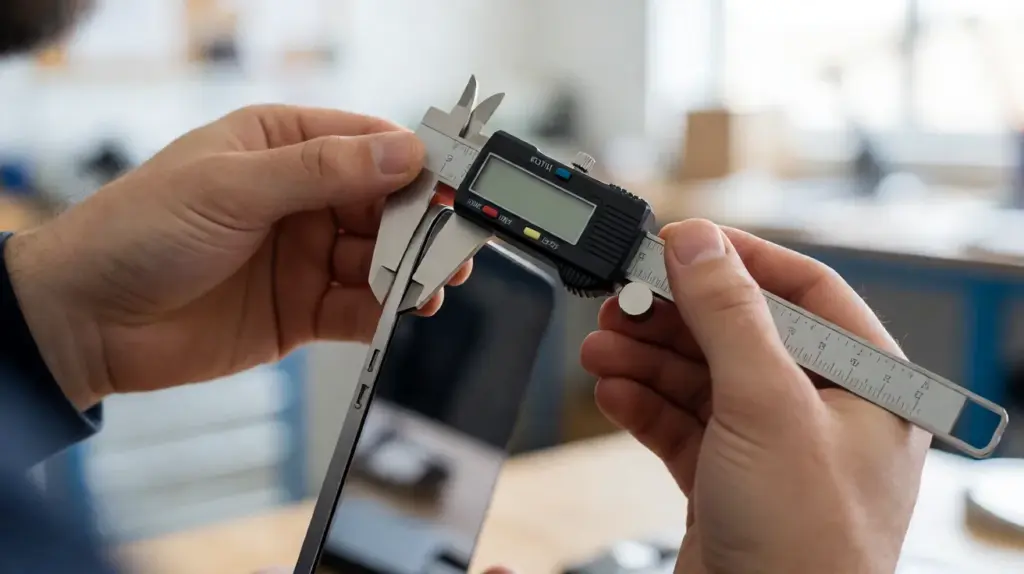
Special touch programs each carry their own tuning cost, so name them in the brief rather than finding them at sample review. Glove operation, wet hands, sensing through thick cover glass, and a specific touch point count all change the controller setup and the test method. State the surface treatment you want, whether glare is a problem, and what the sample has to prove before an order follows.
Environment and Mounting Details to Give
Environment decides component grade, ختم, and the test regime sitting behind the price. Indoor or outdoor comes first, then the temperature range the unit sees at the machine rather than the range printed on a weather page. تراب, washdown, oil mist, and direct sunlight each pull the enclosure and the glass in a different direction. Buyers comparing outdoor builds will find the ingress classes explained in the guide to IP65 rated touch monitors.
Wide temperature work is a parts decision, not a datasheet claim. A display that sits in a cold bay overnight needs components rated for that start, and any heating or cooling solution has to fit inside the envelope you specify. Give the extremes, the duty cycle, and whether the unit runs continuously or wakes on demand.
Power belongs in the same group as environment. State the input voltage range available at the machine, whether the supply is shared with motors or drives, and whether the unit needs its own breaker. A wide DC range, a protected input, and an isolated power design are three different answers, and each one prices a different board.
Mechanical inputs decide the tooling line. A catalog model quotes from its model number, while a cutout, a bracket, or a sealed front face needs dimensions before anyone can price sheet metal. Give the fixing method, the cutout drawing, the enclosure material and color, and where a logo or label sits. A sketch with measurements is enough to start, and a tolerance list is enough to prevent an argument later.

A drawing answers the questions a paragraph leaves open, and a supplier cannot assume a cutout from prose.
Computing, Volume, and Market Inputs
Decide whether the brief describes a display or a computer with a display attached, because that choice moves the board, the power supply, and the license line. The comparison of a touch screen monitor and a panel PC covers the trade-offs. State the operating system, the processor class, الذاكرة والتخزين, the port list, and the input voltage. A serial port, a second network jack, or a wide DC range each shift the number.
Quantities belong in the brief as a shape rather than a single figure. Pilot units, an annual estimate, and the reorder rhythm let a factory price the pilot against real volume instead of a worst case. ال one-piece MOQ route explains what a single unit does and does not commit you to. Minimum order figures differ across this site’s own pages, so treat each one as a stated limit rather than a rule. The support page answers that one unit is welcome, while the process guide lists about 300 units for a fully custom display module.
The final two lines are the ones buyers leave blank. State the destination market and the certificates you need, because power supplies, وضع العلامات, and test scope follow that answer. ال certification requirements by market guide lists which marks sit where. Then write the trade term with a named place, since a delivery term allocates cost and risk rather than describing a price.
United States sale of goods law makes that point in writing. Section 2-319 of the Uniform Commercial Code treats F.O.B. as a delivery term, requires the buyer to give needed shipping instructions in time, and lets the seller treat silence as a failure of cooperation. A blank trade line leaves both sides carrying a risk they have not described.
What Happens After the Brief Goes Out
A complete brief moves through a predictable loop. Clarification questions cover anything ambiguous, an engineering review checks whether the custom items can be built, and the quotation then arrives split into separate lines. ال OEM/ODM process guide on this site describes that route from sketching and structural design through prototype production to finished product.
Timing follows the same split. That guide puts modular prototypes at four to eight weeks and fully custom designs at eight to sixteen, with three to six months from requirement to volume production. Component prices move during that window, so a quotation carries an expiry date and a comparison needs one short collection window rather than a scattered quarter.
The reply itself is a supplier test. A factory that returns three sharp clarification questions has read the brief, and one that returns a total with no questions has priced something else. Note which assumptions a quotation names in writing, since those lines become the argument later if the build diverges.
Ask for the quote as lines rather than a total, and the comparison becomes arithmetic. Request the engineering figure, the tooling figure where one exists, and the unit price at each quantity on separate rows. ال kiosk manufacturer selection guide carries the fixed template for that job, including the rows on samples, freight terms, and spares.

How TouchWo Turns a Brief Into a Quote
ال customization page lists ten dimensions a buyer can specify: مقاس, screen, إعدادات, واجهة, الوحدة النمطية, material, appearance, شعار, لون, and installation method. Those map onto the seven input groups above, which makes the page a useful check that nothing in the brief is missing. The same page sets out an eight step route from requirement confirmation to post-sales launch.
Published figures on this site show where the work happens. The About page describes five in-house supply chains, a class 100 dust-free lamination room, and glass-to-glass and glass-to-film bonding. The manufacturer pages state that in-stock standard models dispatch within two to five days, while custom goods run approximately two weeks or two months. The support page answers inquiries within seven hours and lists 455 days of free spare parts replacement.
The inquiry form on the TouchWo site asks which industry a project serves before it asks anything technical, which mirrors the order of information this guide recommends. Start there with the application and the environment, then add the specification groups. Send the drawings and the acceptance lines in the same message, and the reply is a quotation you can place beside two others without guessing.

أسئلة مكررة
What is the minimum content of an OEM touchscreen quote request?
مقاس, دقة, سطوع, touch type, نظام التشغيل, pilot quantity, annual estimate, and destination market cover the minimum. A request carrying those lines earns a priced configuration rather than a placeholder figure. Anything shorter invites a reply written around assumptions the supplier chose alone.
Do I need drawings before a supplier can quote?
Catalog models quote from a model number, so no drawing is needed to start a conversation. Custom cutouts, بين قوسين, and sealed fronts are a different case, since those dimensions define the sheet metal work and the tooling line. A sketch with measurements is enough for a first number.
Why do suppliers ask for annual volume and not just the pilot?
Volume changes component pricing and the platform a factory is willing to commit to a project. A pilot priced against a realistic roadmap avoids a repricing event when the second order arrives with the same specification. The alternative is a supplier protecting itself against a run that may never come.
Can one brief cover several configuration variants?
نعم, and it is the efficient route for a family of machines. Write one baseline brief, then add a short variant table covering the lines that change, such as memory, سطوع, or touch structure. Each variant then carries a comparable number on the same page.
What should the sample prove before production?
Two or three acceptance lines do most of the work: touch behavior with gloves or wet hands, readability under the lighting at the site, and fit inside the cutout. Agree them in writing before the sample ships rather than after it arrives on a bench. The sample report then has a pass mark.
الأفكار النهائية
An OEM touchscreen quote is a document about one specific machine, and the brief is what makes it one. The seven input groups close the gaps a supplier would otherwise fill alone. Drawings, كميات, and acceptance lines then let two other factories price the same object, which is the point of the exercise.
Write the brief once, keep it under version control, and send the same file to every supplier inside one short window. Panel prices move, so quotes collected across a quarter do not describe the same market. The specification stops drifting mid-project, and the comparison stops being a negotiation about what was included.