A kiosk may meet the quoted specifications but still fail at installation: the card reader does not fit, or the printer has no driver for your system. Choosing a kiosk manufacturer means checking how they handle integration, ujian, and changes before you order.
If you are still comparing formats or suppliers, see the types of kiosks dan kiosk wholesale suppliers. Di sini, we focus on what to verify with a manufacturer before placing an OEM order.
What Should You Define Before Contacting a Kiosk Manufacturer?
Send a function list, a site plan, and a peripheral list, and most of the vague answers disappear from the quotes.
Suppliers answer the question they receive. A brief that says “23-inch kiosk with printer” invites a catalogue unit and a friendly price. A brief that says where the machine stands, what a customer touches, and what a technician opens does the opposite. Build five blocks before you email anyone.
Deployment and Site Reality
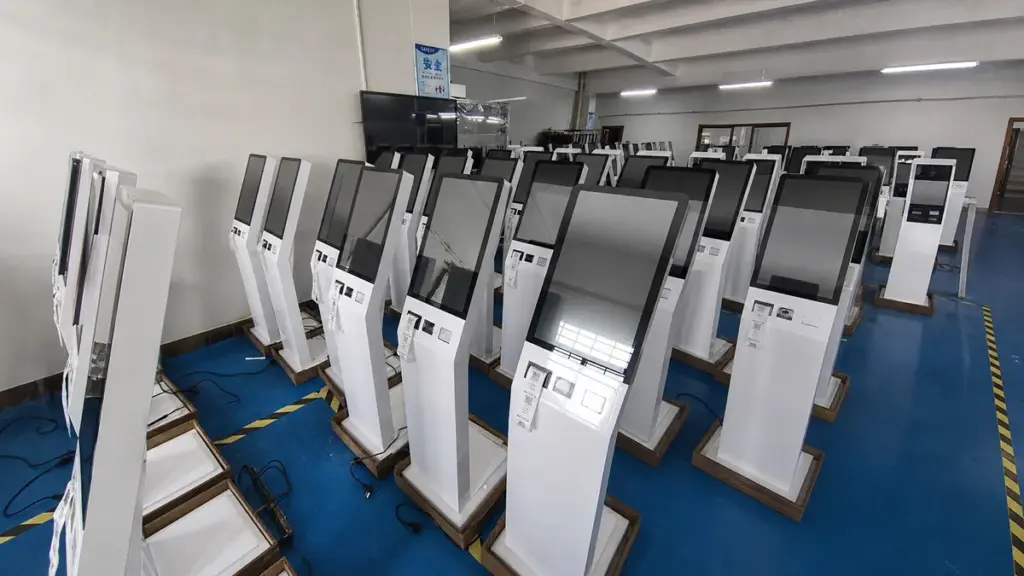
Write the room, not the wish. Record indoor or outdoor placement, ambient temperature range, daylight exposure, and the mounting condition: concrete wall, studs behind plasterboard, or free-standing on a finished floor. Note power and data routes, plus the cable path length from your switch and any network drop that must pass through the cabinet. A supplier who knows one cabinet feeds the display, a printer, and a scanner from a single inlet sizes the internal power distribution differently. State the input voltage range and plug type your site provides, then ask the factory to match it.
Interaction and Duty Cycle
State how a person uses the machine. One-tap check-in differs from a nine-step payment flow that a customer completes while holding a tray. Give the target hours per day and the peak transactions per hour.
Those numbers drive backlight life, thermal load, and the choice between a consumer panel and an industrial one. TouchWo’s product pages, contohnya, list its 23.8-inch kiosk LCD with a 30,000-hour LED backlight rating and a 250 cd/m² minimum brightness. That tells you the panel class instead of leaving you to guess.
Perisian, OS Image, and Update Path
Say who owns the application and the operating system image. A factory that pre-installs a Windows build you cannot reproduce later creates an audit problem at the first redeployment. Name your target OS, the driver package your peripherals need, and how you will push updates. The touch screen monitor compatibility guide covers how driver support differs across Windows, Android, and Linux builds, which is the conversation to have before you sign anything.
Service, Spares, and Escalation
Define what happens at 21:00 on day 400. Which parts do you stock, who ships a replacement, and what does a technician need to open the machine without voiding a warranty? A lockable side-opening panel a store associate can open beats a cabinet that needs a field engineer for a jammed receipt roll.
Which Parts Must the Manufacturer Build or Integrate?
Most disputes about a kiosk manufacturer trace back to one blank cell: nobody owned a part. Read the table below as the scope map you fill in during the first technical call. Every row asks the same three questions: what is in scope, who owns it, and which document proves the answer. Attach the finished version to your RFQ.
| Scope to Confirm | Responsible Party | Evidence to Request |
|---|---|---|
| Cabinet and bezel: kepingan logam, welding, finish, tooling | Kilang, or the machine shop it names | Drawing set, finish samples, revision block |
| Display and touch: panel lamination and assembly | Built in house, or mounted from a purchased panel | Panel datasheet, touch controller model |
| Compute: board, ingatan, penyimpanan, burn-in | Supplier builds, or installs your board | Cpu, Ram, SSD options in writing |
| Peripheral: pengimbas, printer, card reader, kamera | Supplier brackets and integrates your chosen models | Model numbers plus driver package |
| Perisian: OS image, your app, test script | Split by line: factory loads, you own the application | Test report per serial number |
| Service parts: consumables, disimpan, warranty pass-through | Agreed owner per part before the first shipment | Spares list with agreed lead times |
Where a supplier buys a part rather than building it, the risk is not the purchase. It is the invisible hand-off. Ask which vendor’s scanner sits in the bezel today, and what happens when that vendor changes a connector on a new revision.
A manufacturer that controls its own touch panel lamination and metal work can usually tell you, because the same plant assembled the unit. TouchWo’s company profile lists five in-house supply chains, covering touch panel production, kerja kepingan logam, aluminium machining, PC assembly, dan r&D, as the reason it quotes custom cabinets directly. Verify that claim for your own configuration with a plant visit or a video audit, and check which steps a candidate subcontracts.
Peripherals deserve a model number, not a category. The 23.8-inch self-service touch kiosk GD238D2 page lists optional QR code scanner, receipt printer, and card reader hardware. It also shows CPU, ingatan, and storage choices, which is the level of detail your own brief needs. A competitor quote that says “printer included” without a model cannot be compared with it.
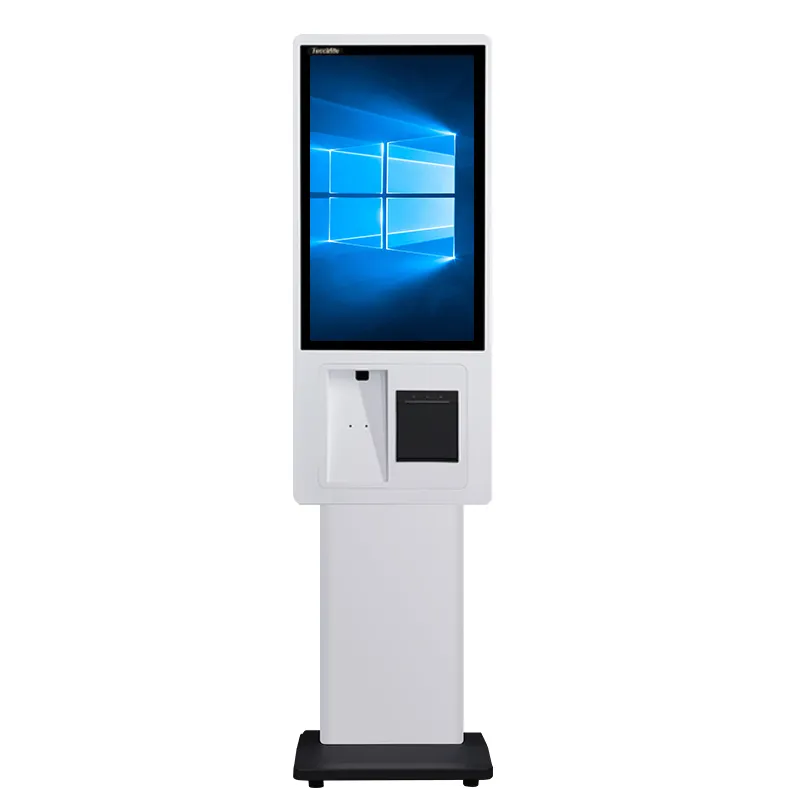
One more line belongs in the map: who owns the failure. When a card reader stops accepting a tap, your team needs to know whether the fix sits with the peripheral vendor, the integrator, or your software. Write that escalation path into the same table.
How Do You Compare Customization and Engineering Support?
Customization claims come in two grades. The first is a colour change and a logo on an existing shell, which most factories handle. The second starts when your hardware does not fit the standard cabinet. Think of a scanner recess at the height your checkout flow requires, a ventilated base for a hot climate, or a bezel that clears a wall bracket behind glass.
Ask for the Engineering artefacts
Request the drawing set, the tolerance notes on the welded frame, the cable routing diagram, and the thermal reasoning behind any vent placement. A supplier who built the tooling in-house answers with files. A reseller answers with a brochure. The customization service page is where a manufacturer states what it changes and what it holds fixed. Read it as a scope claim, then test that claim in your first call.
Count the engineers, not the sales staff
Ask who signs your drawing. Find out how many mechanical engineers sit on the project. Ask whether one person owns your account through production, and how a change request travels from your email to the shop floor.
TouchWo’s company profile states its capability in its own wording: 30+ technical engineers in the design group, dan 11+ production lines for complete PC assembly. Read such figures as published claims rather than proof. A headcount does not tell you who reviews your files. Ask each candidate to name the engineer who owns your drawings, and confirm that person stays on the project through production.
Test the response to a hard constraint
Give each shortlisted kiosk manufacturer the same awkward requirement taken from your own deployment. Ask for a recess behind the bezel sized to your coin return, or a bottom-feed printer a cleaner can reload without a tool. Watch whether the first reply is a question about load and access, or a price. That one exchange predicts the rest of the project better than a factory tour.
Browse the kiosk product range before that call so you can point at a specific machine and ask what it would take to move one component on it. A supplier who works from your reference model gives faster, cheaper answers than one who restarts from a blank sheet. Note the two or three models that fit, and name them in your enquiry so the first reply is engineering rather than a catalogue.
What Should a Prototype Demonstrate?
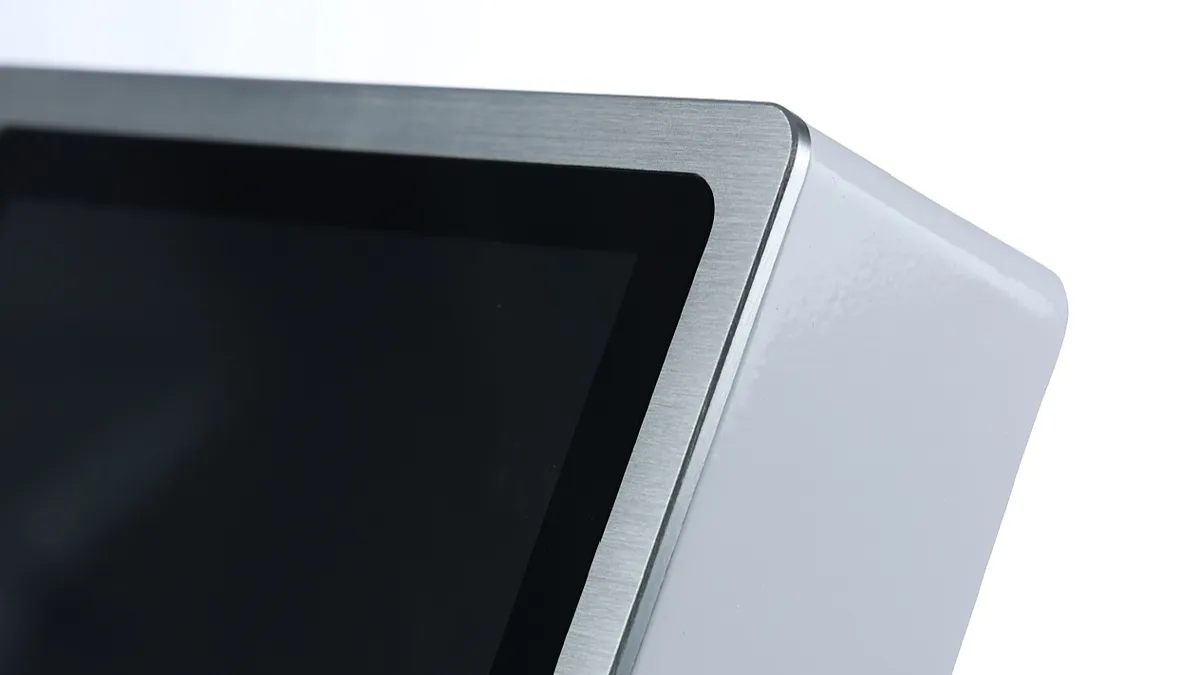
Treat the prototype as a test article, not a photograph for your investors. It should carry the real sheet gauge, the planned finish, the actual peripheral positions, and the same tools your technicians will use on site. Approve nothing that the sample cannot demonstrate.
Run the physical checks yourself
Work every access panel through repeated open and close cycles and watch for a paint edge that lifts or a hinge that binds. Fit each peripheral and run a full transaction, then measure the reach distance for your shortest and tallest staff member. Check the touch surface with gloves if your users wear them. Then confirm the reader position against your payment terminal, because an offset scanner turns a smooth tap into a shoulder twist. Photograph the cable routing inside the cabinet before you approve it, since a serviceable layout matters more than a clean exterior.
Ask for the test report behind the sample
A finished prototype proves assembly; a report proves durability. Ask which tests your configuration passed and against which standard. TouchWo publishes its laboratory scope on its company profile, listing ESD, temperature and humidity conditioning, insulation and dielectric withstand, lightning surge immunity, and vibration simulation.
Ask for the report behind the exact configuration you are quoting, not a datasheet for a different model. A usable test record names the standard, the condition, and the level applied. It also states whether the sample was a display module or a whole kiosk with its compute and peripherals fitted. If a supplier sends a certificate photo without test conditions, request the report pages that cover your machine.
Read the certification wording carefully
One line on a services page can cover several different documents. CE marking for a kiosk normally rests on a conformity assessment procedure, a technical file, and a declaration of conformity naming the model. FCC, ROHS, CCC and PSE each answer to a different rule, so treat them as separate scopes rather than one whole-machine certificate. TouchWo’s company profile states that every series has passed the CE, FCC, ROHS, CCC and PSE certification, which is the factory’s wording for its own series list. Ask for the documents covering the delivered model and your destination market, then have your importer or compliance lead review them before shipment.
Quality management gives a separate reference point. ISO 9001 is a published standard for a company’s quality management system, not a test method for a kiosk. A certificate describes how a supplier runs its processes; it says nothing about your machine or any particular model. The official page lists the current edition and its status, so ask which edition a supplier’s certificate names. Then request the scope and the validity dates.
Akhirnya, decide what the sample costs you later. Keep the approved prototype under lock and key, label it with the drawing revision, and write into the purchase order that production units must match it. Ask which measurements a buyer can check on arrival, since that list becomes your acceptance script at the dock.
How Do You Evaluate Production Consistency and Changes?
A pilot run answers a different question from a prototype. The sample proves the design fits. The pilot proves the process repeats, and that is where a kiosk manufacturer earns a multi-site order. Ask what a pilot batch includes: how many units, which operators build them, and which inspection records come out of that run.
Fix the drawing revision before production
Insist that every order references a drawing revision and a bill of materials version, and that the factory prints both on the packing list. This one habit removes most arguments about which bezel or bracket shipped. Keep the revision block on your own copy of the drawing, and refuse unlabeled samples during pilot review.
Set checkpoints with numbers you can verify
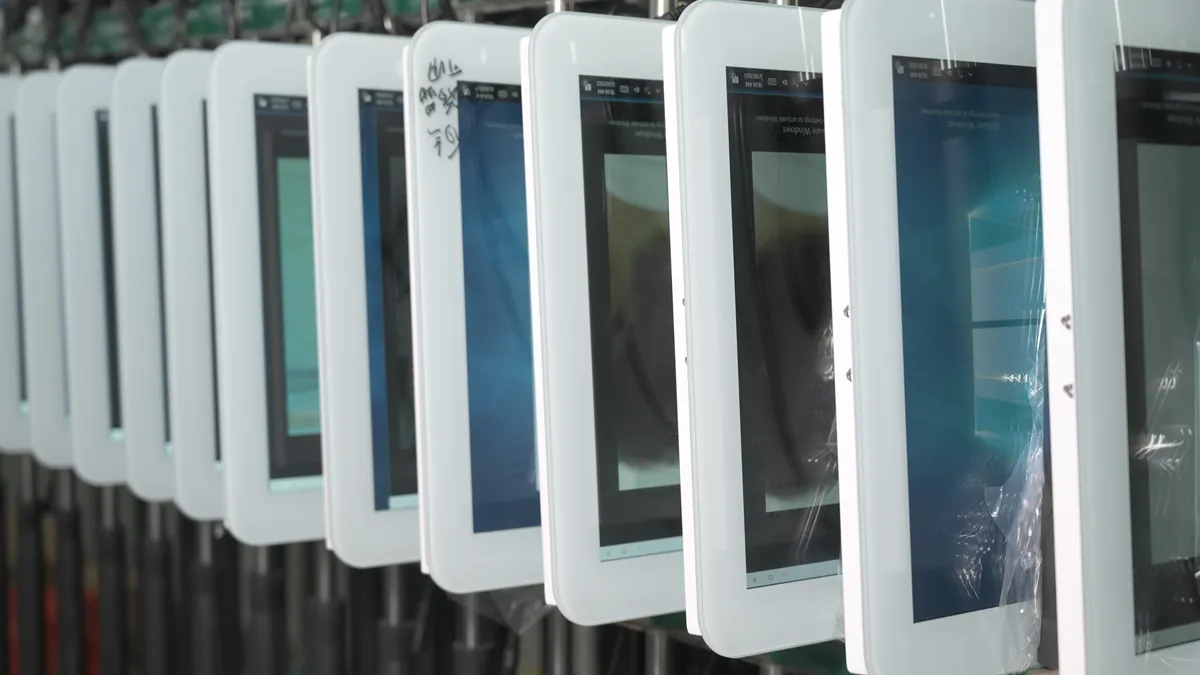
Agree what you inspect and how often. Reasonable checkpoints include first-article approval on the line and random cabinet dimension checks against the drawing. Add a torque or fastening spot check, a functional test of every peripheral on every unit, and a burn-in period before packing. Where an environmental limit matters, ask for the test condition rather than a pass rate, since your site’s temperature and dust load may differ from the plant’s bench.
Control changes in writing
Component substitutions happen: a scanner reaches end of life, a panel supplier changes a driver board, a powder coat vendor switches batch. Ask how the supplier will notify you, what notice period applies, and who re-tests after a change. A factory that runs its own touch panel lamination and metal work can usually trace those substitutions quickly. A buyer relying on subcontractors learns about them when a unit arrives different. Record every accepted change in one log with dates, so a defect six months later has a timeline to point at.
Watch the small tells during the pilot. Panels that need force to close, silk-screen text that shifts between units, or two different screw types in one cabinet all signal a process that has not settled. Send photographs with the serial numbers rather than a general complaint, and ask the plant what it changed on its side before the next batch.
What Should Be Included in a Comparable Quote?
Ask every candidate for the same line items, and reject a quote that bundles them. A comparison only works when both sides priced the same work, so send a fixed template and require a number in each row. State your currency, the Incoterms basis, and the payment stage beside every line so two quotes mean the same thing.
| Quote Line | State Explicitly | Why It Stops Disputes |
|---|---|---|
| Konfigurasi | Cpu, Ram, penyimpanan, panel, touch model | Both sides price the same machine |
| Peripheral | Jenama, model, antara muka, mounting | No surprise driver or bracket work |
| Tooling and NRE | One-time cost, ownership, transfer terms | Write tooling ownership into the contract |
| Samples | Prototype count, cost, credit rules | Clear budget before sign-off |
| Software load | OS image, your app install, test script | Nobody assumes the other side does it |
| Testing and reports | Which tests, per unit or sampled, records | Acceptance has a paper trail |
| Packaging and freight | Carton size, incoterms, crating, lift gate | Transit damage liability belongs in the contract |
| Warranty and spares | Term, coverage, spares pricing, RMA route | Support cost lands in the same view |
Fill the commercial columns yourself before you send the template: your target unit count, the delivery window, and the change-control terms you will accept. Ask each supplier to price the same quantity breaks, because tooling amortizes differently between a first batch and a later rollout. Line the answers up in one sheet before you shortlist, so a low unit price cannot hide a late change fee.
Read the exclusions line as carefully as the total. “Cable management included” means nothing until you see whether the harness, the power strip, and the peripheral cabling sit inside it. “Warranty one year” says nothing about whether a touch controller or a printer head carries the same term. Put a serial-number traceability requirement in the quote too, since a defect report needs to point at a batch and a date.
A useful test of quote discipline: ask two suppliers the same three questions by email and time the answers. A kiosk manufacturer that replies with a component list, a drawing question, and a named contact is running a process. One that replies only with a number will keep answering that way through production.
Soalan yang sering ditanya
What information should I send a kiosk manufacturer?
Send a function list, indoor or outdoor site photos with power and data routes, and each peripheral’s model number. Add your target operating system image, expected daily hours, and the unit count per delivery wave. Note the access a technician must make, since that shapes the cabinet more than the finish.
Can a manufacturer integrate my own software and peripherals?
Usually, with two conditions. The factory needs the driver and installation steps for your application on its build, and each third-party device needs a documented interface plus a bracket position. Supply sample hardware and an install script early, because a factory that meets a custom driver during a pilot books rework and a new lead time.
Should I approve a prototype before a bulk order?
Ya, and approve it against written checks rather than impressions. Run the access, peripheral, reach, and touch tests you plan to repeat at receiving, then keep that sample as the physical reference for production. Add a pilot run before the full rollout, because one good sample proves the design while a batch proves the process.
Pemikiran terakhir
A kiosk manufacturer earns an OEM order on evidence. Look at the drawing revision it locks, the peripheral model it names, and the reports it attaches to the quoted build. Then check the change log it keeps when a board swaps. Work the sequence in that order: define the scope, split responsibility line by line, and compare engineering output rather than adjectives. Test the prototype as a test article, fix drawing revisions for the pilot, and put every candidate on one quote template so the totals mean the same thing.
Share your kiosk function list, deployment plan, and required peripherals with Touchwo to discuss a project-specific configuration and prototype.