A touch screen certification is a written answer to a regulator’s question. Each market asks its own question about the same piece of hardware, and the paperwork that answers one does not answer the others. A monitor cleared for a shop floor in Berlin can still stall at a shipment check in California, and the reason is documentary rather than technical.
This guide gives touch screen certification by market for a monitor z ekranem dotykowym, a panel PC, or the kiosk hardware built around them. It separates product certificates from factory system certificates, names who legally holds each file, and gives a verification routine to run before an order is placed. Every claim about TouchWo’s own coverage points to a page on this site so you can check it directly.

What a Touch Screen Certification Covers
Three separate questions sit behind the marks printed on a datasheet. The first asks whether the device is electrically safe to touch and to operate. The second asks whether it emits radio noise that disturbs other equipment, and whether it keeps working when disturbed. The third asks what the unit is made of.
Safety and compatibility rules produce the familiar marks, and substance rules usually ride inside the same declaration rather than earning a logo of their own. That layering is why a supplier can hold a genuine file and still be unable to name the standard behind a claim. Ask which question a document answers before judging whether it is missing.
A second distinction matters more than buyers expect. Product certificates attach to a model, i CE, FCC, CCC, PSE, and a RoHS declaration all name a device. Factory system certificates describe the management process behind it, i Expertise page on this site lists ISO 9001, ISO 14001, and ISO 45001 alongside the product marks. Neither type substitutes for the other.
A product certificate says this model conforms. A system certificate says the factory runs a managed process. Buyers normally need both, and neither one answers the other question.
The practical test is to read every certificate as a claim about one object. A quality-management certificate says nothing about whether a given display model was measured for emissions. A conformity declaration says nothing about how consistently the line that built it is audited. Corporate procurement teams ask for both because each closes a different gap.
Certification Requirements by Market
The table below maps each touch screen certification mark to the regulator behind it and to the detail that changes a buying decision. Treat the middle column as what a customs officer or a distributor will ask for, and the last column as what to settle in writing. Coverage for one model is a document question, not a table question.
| Rynek | Mark usually required | What you should verify |
|---|---|---|
| European Union | CE, covering EMC and RoHS | The directive list named in the declaration |
| United States | FCC under Part 15 | The US responsible party named on file |
| Canada | ICES, usually handled with FCC | Whether one report covers both markets |
| Chiny | CCC for listed product categories | The exact model printed on the certificate |
| Japonia | PSE, plus radio approval for Wi-Fi | Whether the adapter or the display is regulated |
| Australia and New Zealand | RCM | Who holds the local supplier registration |
| United Kingdom | UKCA, with CE acceptance extended | The current rule for your product category |
| India and South Korea | BIS registration, KC marking | The certificate holder’s legal name |
Two rows deserve explanation because they surprise buyers. Japan’s PSE requirement attaches to regulated electrical appliances, and a display powered by an external adapter can leave the adapter as the regulated item. The same order can also carry a separate radio approval for its Wi-Fi module, which is a different law with a different certificate.
The United Kingdom row is the one most often misquoted. UKCA marking exists for the British market, and CE acceptance in Great Britain rests on government policy rather than on a fixed deadline. Confirm the rule for your product category in writing instead of treating either mark as a general permission.

A physical layer sits under the paperwork, and it is where certificates and shipments disagree most often. A unit built for Europe runs on 230 volts with a European plug, while a North American build runs on 110 volts with a different connector. The regional build and the certificate must describe the same object, so request them together.
CE Marking and the EU Declaration
CE marking is a claim by whoever places the product on the European market, not a badge issued by one central authority. For a touch display the declaration normally rests on the electromagnetic compatibility rules and, where the equipment falls inside their voltage band, on the low voltage safety rules. RoHS sits in the same declaration as a separate directive.
That voltage band is a real boundary, and it changes what a monitor’s own file contains. The low voltage rules cover equipment rated between 50 I 1,000 volts alternating current, or between 75 I 1,500 volts direct current. A kiosk samoobsługowy wired for 110 Do 240 volts sits inside that band, while a monitor whose input is 12 volts does not. For the monitor, safety conformity usually travels with the adapter.
The consequence for a buyer is concrete. Ask which directives the declaration names, then request the reports behind them. A display and its power supply can be covered by two documents held by two different parties. The 15.6 inch industrial monitor on this site lists EMC as CE and FCC Class B, which is the kind of line item to match against a report.
Most files for this class of equipment are self-declared, which is exactly why the depth behind the mark varies. No third party signs the paperwork for the compatibility rules that usually apply to a display. The technical file is what makes a declaration defensible, and an EU importer can be asked to produce it.
FCC Part 15 and the US Rules
The FCC regulates the radio noise a device emits rather than the safety of its electrical design. Part 15 of the commission’s rules covers unintentional radiators, the category holding any equipment with a digital circuit that switches at speed. A touch monitor or a kiosk controller falls inside it on the strength of its own electronics.
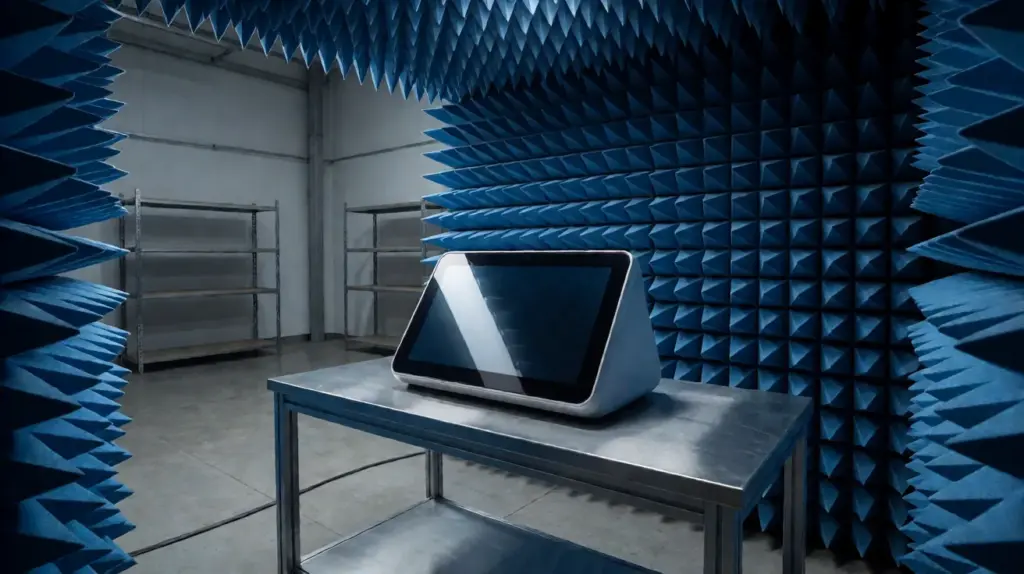
Two details of the US process surprise importers. The first is that most digital devices reach the market under a supplier’s declaration of conformity, not through an FCC filing. That means no public certificate number exists for every model. The second is that the rules place the compliance responsibility on a party located in the United States, a role a foreign factory cannot fill for itself.
Class A and Class B describe the environment a device is meant for, and the difference is measured in permitted emission levels. Class B is the tighter limit intended for residential use, and it is the class most buyers expect to see quoted. Where a product page names a class, match it against the report rather than the marketing copy. The full rule text, including the class definitions and the required compliance statement wording, is published in 47 Część CFR 15.
The engineering behind a passing result lives in the enclosure and the cabling. A board can pass in one housing and fail in another, which is why a form factor change after testing is a compliance event. That relationship is covered separately in EMI and ESD protection in industrial touch screen design, and it matters whenever a project changes shape after the reports were issued.
RoHS and the Material Restrictions
RoHS restricts named substances in the homogeneous materials inside a product, which is a materials question rather than an electrical one. The current European text is Directive 2011/65/EU, and its annex lists ten restricted substances with a maximum concentration in each material. Cadmium is capped at 0.01 per cent and the other nine at 0.1 per cent.
Four of those ten are phthalates added by a later delegated amendment, and older supplier documents sometimes list only six. That gap is a quick tell about how current a factory’s materials file really is. Ask for the substance list with its revision date rather than a generic statement of compliance.
Other markets run their own versions of the same idea under different paperwork. China applies its own hazardous substance limits together with a disclosure and marking requirement, and the wording differs from the European one. Treat a RoHS report as a materials document that supports a declaration, never as proof that a product is electrically safe.
RoHS answers what the unit is made of. CE answers whether it is safe and quiet enough to sell. FCC answers whether it disturbs radio service. Three questions, three documents, one product.
How to Verify a Supplier’s Certificates
Certificate claims are cheap to print and quick to check, and the routine takes an afternoon. Work through the list below before a deposit is paid, and keep the answers in one folder rather than across an email thread. The point is to link every mark to a document that names your model.
- The certificate PDF, checked against the exact model or series string in your quotation.
- The issuing laboratory’s name and accreditation, visible on the report cover.
- The standards listed inside the report, matched to the rule being claimed.
- The validity dates, and confirmation that the document covers the power build you ordered.
- The declaration of conformity, with the signatory’s company name and the directives cited.
- A written note of who holds each file and who must produce it on request.

The classic failure is not a forged certificate. It is a genuine certificate for a neighbouring model, offered in place of the one you are buying. Nothing on the page looks wrong unless the model string is read against the order. A single character in a suffix can move a unit outside the tested configuration.
Responsibility is the part that contracts decide rather than laboratories. In the European Union the manufacturer issues the declaration and holds the technical file, while the importer carries its own document duties. In the United States the FCC process needs a domestic responsible party. Name both roles in the purchase agreement, along with who maintains the files across a product revision.
The About page on this site states that every series has passed CE, FCC, RoHS, CCC, and PSE. The Expertise page repeats that list alongside three ISO system standards, and describes ten outbound tests on touch screen products including a 48 hour powered aging run before packing. The testing detail is set out separately in how industrial touch monitors are tested before shipment.
Coverage still varies by series, and no supplier should be asked to claim otherwise. The useful question is narrower than the marketing one: which certificate exists for this model, in this power configuration, for this destination. A factory that answers with a named document is easier to work with than one that answers with a logo wall.
Często zadawane pytania
Does one touch monitor need both CE and FCC?
Tak, when the same design ships to both markets. One hardware platform can hold both sets of documents, but the declarations rest on different rules and different test reports. The regional power build changes too, so match each certificate to the configuration you are actually buying.
Is RoHS part of CE marking?
For European sales, RoHS compliance sits inside the CE framework and the same declaration covers it. It is still a separate directive with its own substance list and its own reports. Other markets apply their own hazardous substance rules under different names, so a European file does not transfer automatically.
Are UL or ETL mandatory in the United States?
For most commercial and industrial equipment, no federal rule requires either listing. Retail channels, insurers, and some facility teams still demand one as a condition of purchase, which makes it a market access requirement rather than a legal one. Ask your customer which body must appear on the label.
What is the difference between CE and ISO 9001?
CE is a product declaration: it says a model meets the European requirements that apply to it. ISO 9001 is a factory certificate: it says the company runs a documented quality management system. The two answer different questions, and an auditor usually asks for both because neither covers the other.
Who keeps the CE technical file?
The manufacturer issues the declaration and holds the technical file, and that file must be capable of being produced when an authority asks. An EU importer carries its own documentation duties, so the practical answer depends on who placed the product on that market. Write the obligation into the supply agreement before the first shipment.
Ostatnie przemyślenia
A touch screen certification is not a hurdle a supplier clears once and forgets. It is a set of documents that must keep describing the product you are buying this quarter, in the configuration that leaves the factory this quarter. The buyers who get burned are rarely the ones holding an uncertified device. They are the ones who accepted a mark without the file behind it.
Start from the destination rather than from the logo. Name the market, name the model, name the power build, and ask which certificate covers exactly that combination. A factory with a real file will answer with document numbers and dates, and you can check each one against the regulator’s own text in an afternoon.