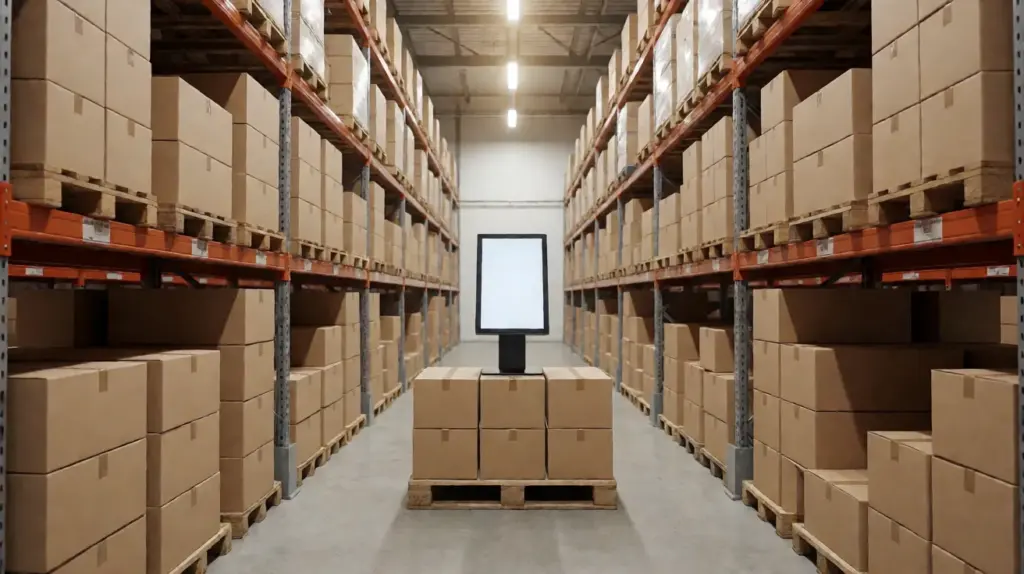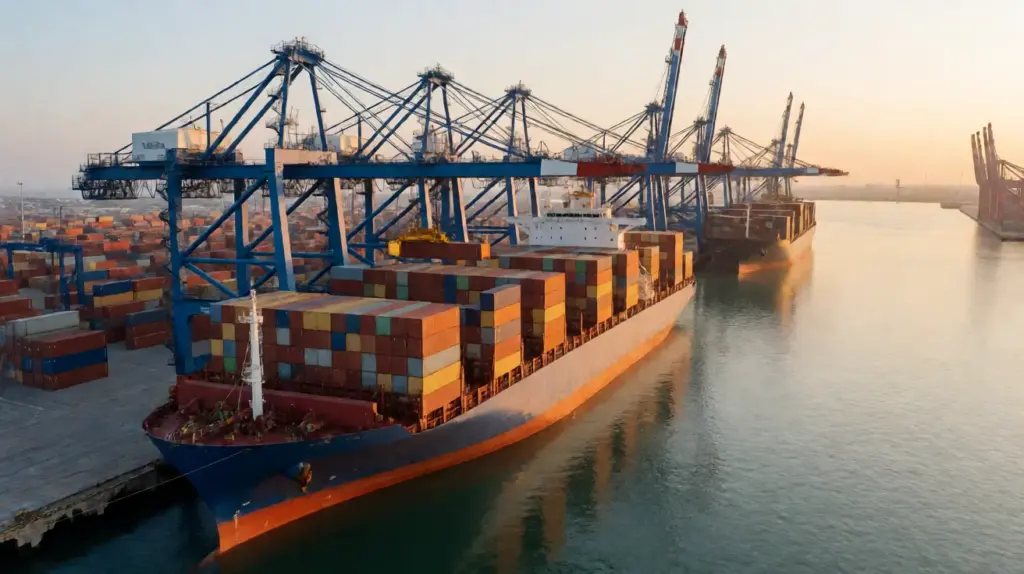
A touch hardware supply chain is a list of owners before it is a list of steps. The stages themselves are predictable, and most factories will name them in the same order. What changes between suppliers is who holds each stage, and that answer decides more about your schedule than any single line in a quotation.
This guide maps those stages, compares three sourcing models, and shows what each one changes about lead time, change control, and quality accountability. The step-by-step build sits in a separate article on the OEM/ODM process. This page stays on ownership, and every claim about TouchWo points at a page on this site that you can open yourself.
What a Touch Hardware Supply Chain Includes
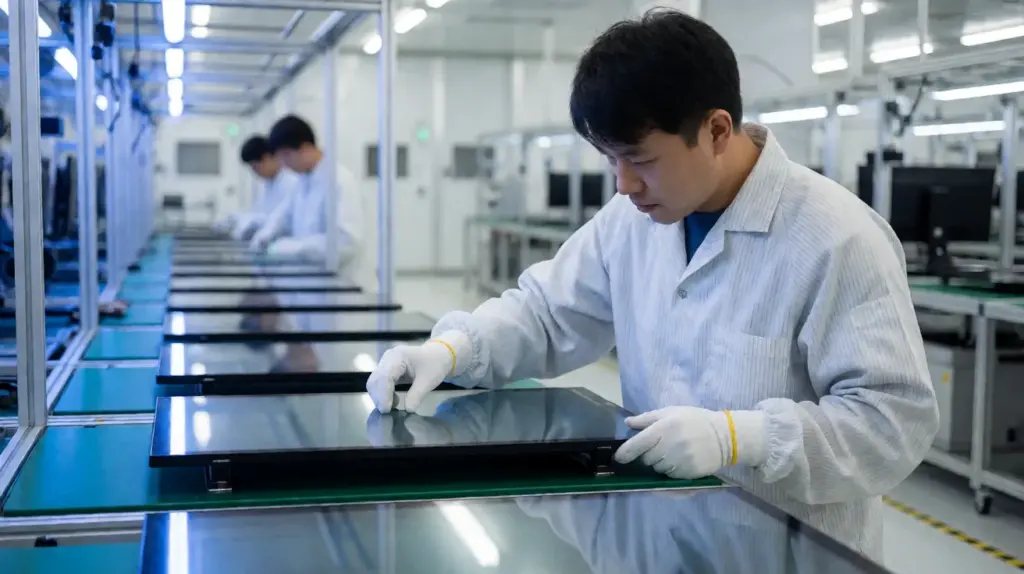
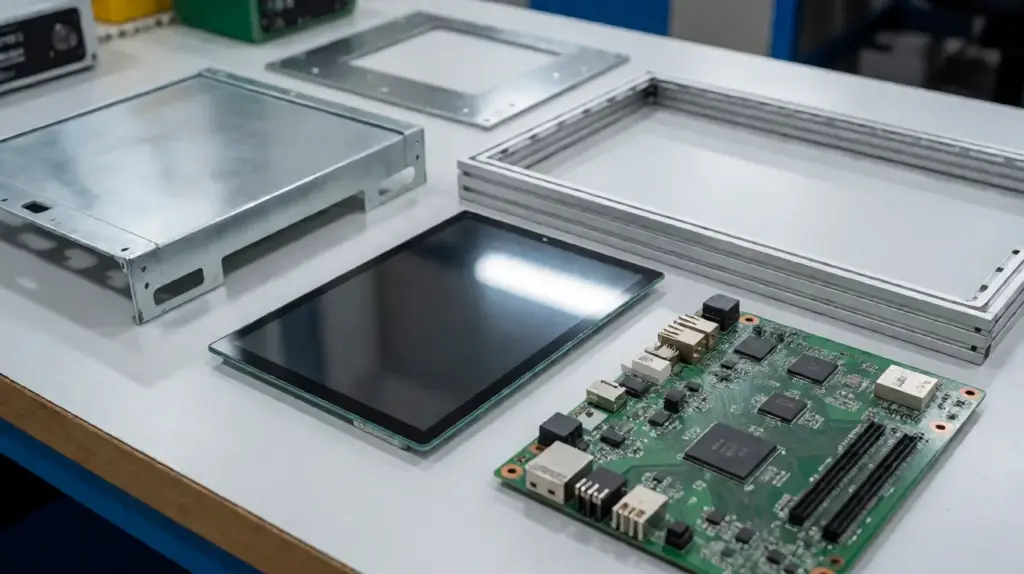
Five stages sit between raw material and a packed unit, and each one passes a different object to the next. The first four can be bought from four different companies, which is why a single supplier name hides so much of the picture. Most buyers meet the chain at its final station, long after the decisions that shaped it were taken elsewhere.
- Touch sensor work: sensor film or glass bonded to cover glass or to the display stack.
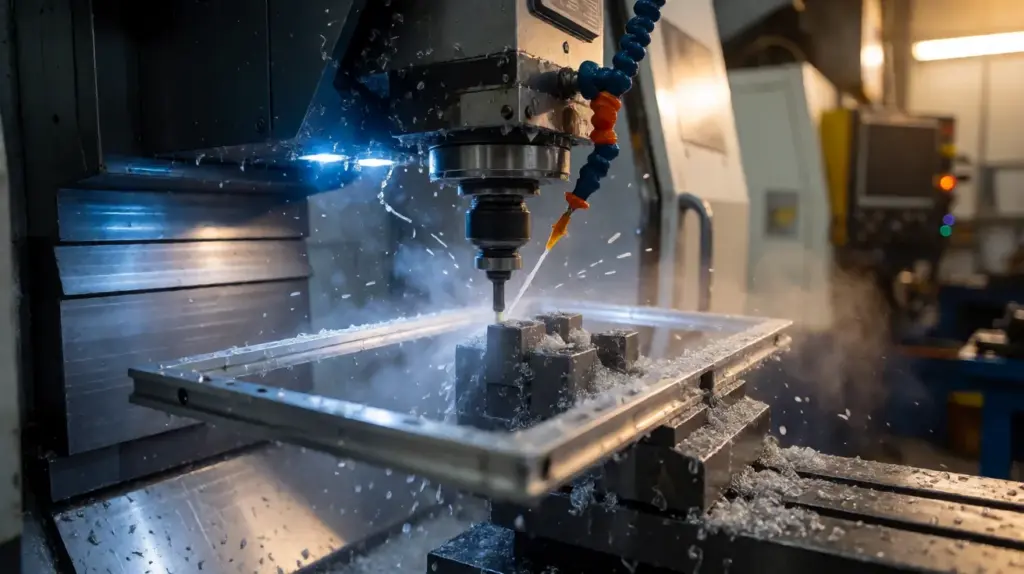
- 構造: sheet metal formed into chassis and brackets, or aluminium machined into bezels and frames.
- エレクトロニクス: mainboard, power supply, interface boards, and the cabling that joins them.
- 統合: touch controller matching, firmware tuning, and the fitting of sub-assemblies into one housing.
- Outbound verification: functional testing, エージング, packing, and the documents that travel with the shipment.
The display panel is the one major part that assemblers buy rather than build, and the distinction shows up at quote time. Cell glass, driver integrated circuits, and touch controllers come from component makers whose own order books set a floor under your lead time. A supplier who claims to control those parts is describing a different business model from the one you are talking to.
A specification sheet is where the chain becomes visible to a buyer. の タッチスクリーンモニター category lists interfaces, enclosure treatment, and power input for a whole range. A single model page such as the 15.6 インチ産業用モニター does the same for one build. Each of those lines is the output of a decision taken upstream by someone.
A quotation names one company. The chain behind that name lists several, and the distance between those two counts is where schedule risk usually hides.
Three Sourcing Models Compared
Sourcing models differ by how many stages sit under one management system, not by the quality adjectives printed beside them. Three positions describe most of what a buyer will encounter in this category. Each one moves coordination work rather than removing it.
| Sourcing model | What one supplier controls | Coordination load on you | Where trouble appears |
|---|---|---|---|
| Contract assembly | Final integration, テスト, and packing | 高い, across every stage | At handoffs, late in the schedule |
| Partial integration | Structure plus assembly, sensors bought in | 中くらい, mostly at the sensor boundary | Between the sensor vendor and the housing |
| Vertical integration | Sensor work, 構造, assembly, and test | Low for hardware, normal for components | At capacity limits rather than at handoffs |
None of these three is dishonest, and none of them is free. A contract assembler sells you scheduling flexibility and a low fixed cost base, and buys nearly every part of your design from someone else. A vertically integrated factory sells short loops between the workshop and the drawing board, and asks you to accept its equipment list as the boundary of what is possible.
The practical difference is which changes a supplier can absorb without a commercial event. A bezel that needs a little more clearance is a conversation with a machining cell when the frame and the assembly line share a floor. The same change crosses a purchase order when they do not, and a purchase order keeps its own calendar.
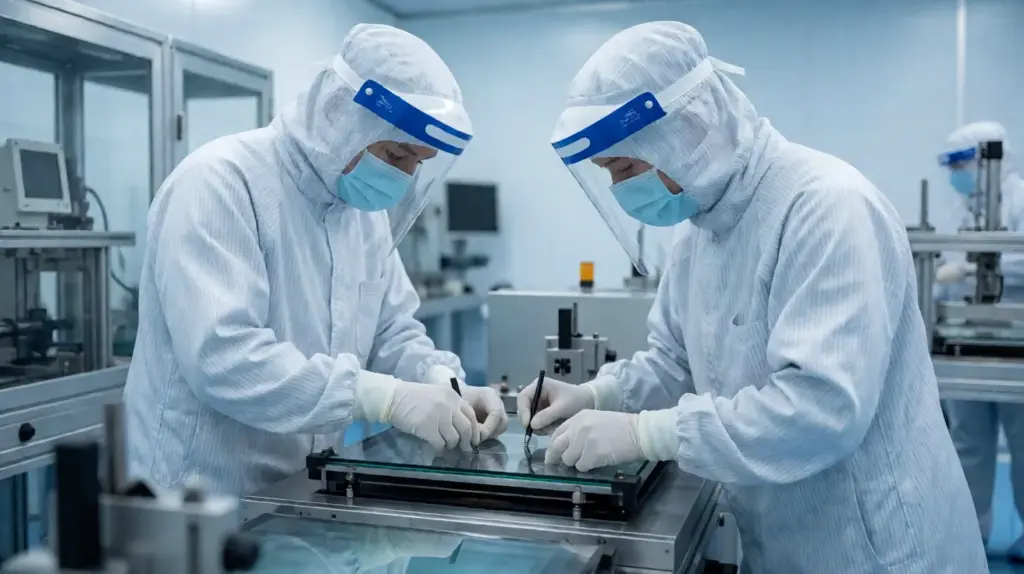
Lamination is the stage most often outsourced and most often described as in-house. A cleanroom is expensive to run, and a photograph of one is cheap to take. の About page on this site lists a Class 100 dust-free workshop running G+G, G+FF, and TP+LCM bonding. That is a specific claim, and a visit tests it in an hour.
What Ownership Changes for Lead Time and Cost
Lead time is a sum of waiting periods, and every boundary between owners adds a queue of its own. Stages under one plan can overlap in ways that separate companies cannot, because overlap is a scheduling decision rather than a negotiation. A housing can be machined while the sensor is still in lamination when both sit inside one factory plan.
Cost behaves differently, and the usual assumption gets the direction wrong. Integration removes handoff margins, not material cost, so a factory that owns more stages still buys glass, チップ, and boards at prices close to everyone else’s. Where integration shows in money is in rework and change orders, because those stop being commercial events and stay engineering events.
For small batches the effect is larger than it looks at volume. A one-piece run has no spare sub-assembly waiting when a part fails inspection, and a replacement bought from a third party arrives on that vendor’s schedule. の one-piece MOQ guide covers what a single-unit order commits you to, そして custom touchscreen OEM pricing covers where the non-recurring charges sit.
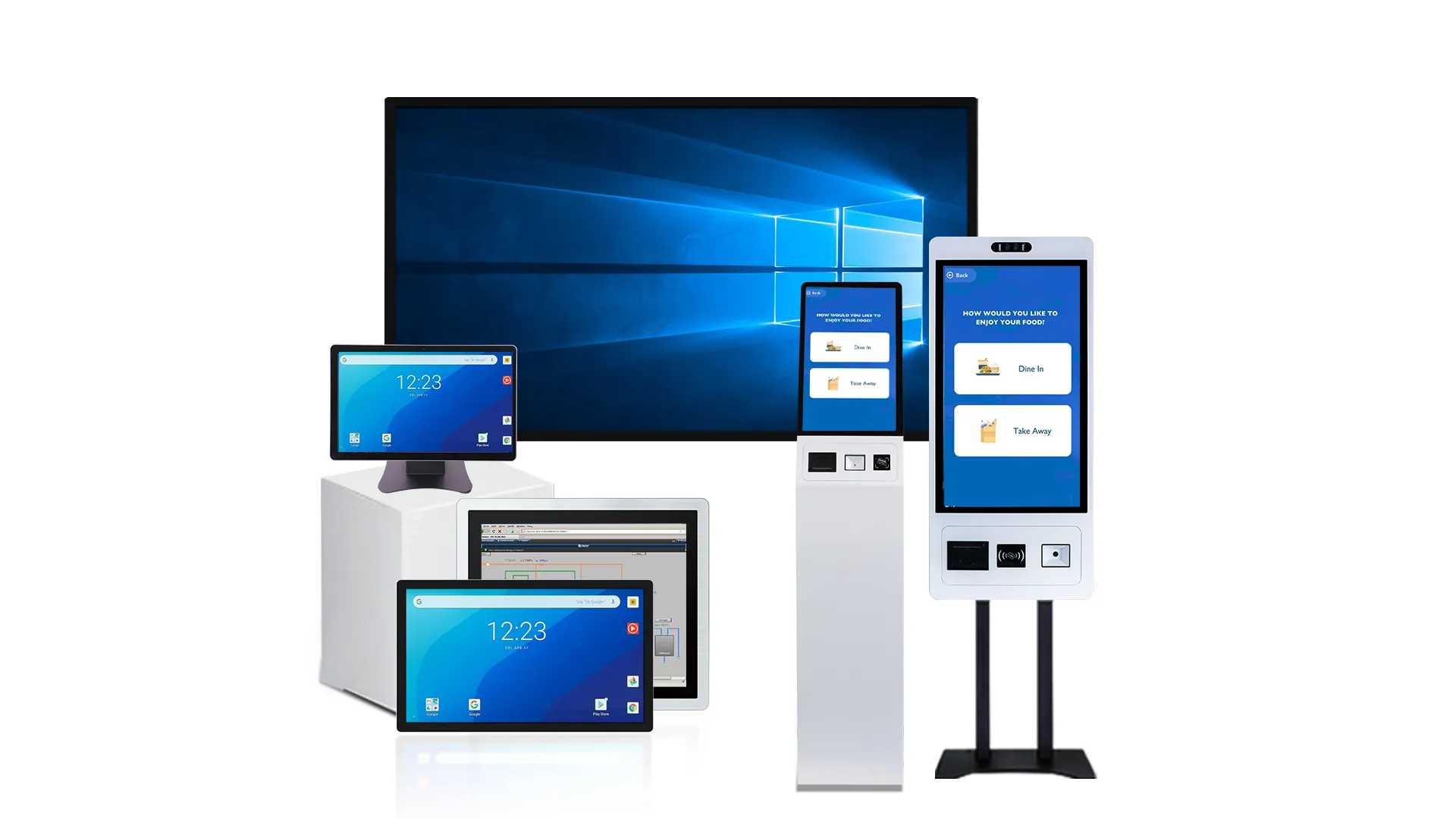
Custom kiosks add a further tier, since printers, スキャナー, and card readers arrive from peripheral makers as finished modules. の セルフサービスキオスク category is where that integration work is visible. A peripheral list is the part of the chain no monitor factory controls by itself, and a quote should say who supplies each item on it.
The engineering effort behind a short chain is real, and it is worth naming what it does not cover. touchwo's customization page describes a route from sketch to finished product across ten dimensions. A route is not the same thing as owning every material at the start of it, and the honest version of any capability list has edges.
Where Quality Responsibility Sits in the Chain
Most of quality work is record-keeping, and the useful questions are who keeps which record and for how long. A defect found in the field becomes a paper exercise before it becomes an engineering one. The answer you need names a batch, a supplier, and a date, rather than a symptom.
Two document types get confused in supplier audits on a steady basis. A product certificate names a model and a test standard. A management-system certificate names a factory and a process. ISO 9001 belongs to that second group, and it describes how a company manages quality rather than whether your unit passed a test.
Origin documentation is the other exposure, and it travels with the importer rather than the exporter. US buyers face a rebuttable presumption under the UFLPA rules enforced by CBP. Goods made wholly or partly in the Xinjiang region, or by entities on its list, may not enter unless that presumption is rebutted. Rebutting that presumption takes supply-chain documentation, and CBP publishes importer guidance and an example document list for it. An assembled display carries components from many suppliers, so the question applies to those parts as well as the finished unit.
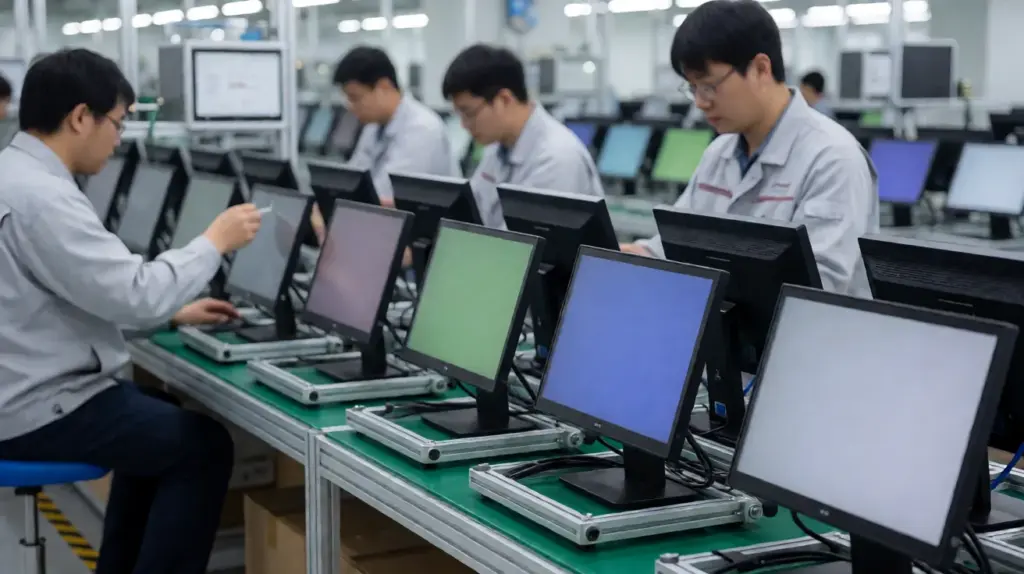
Incoming inspection is where the seams of the chain get checked, and it is worth asking who performs it for bought-in parts. の Expertise page on this site describes ten tests on finished products, including a 48 hour powered aging run before packing. The method detail behind those tests sits in how industrial touch monitors are tested, and the record format is the part worth requesting.
Ask who would hold the record for this batch in eighteen months, and who would produce it. That answer tells you more about the chain than any factory tour.
How to Verify Who Controls Each Stage
Verification is mostly a request for evidence that costs a supplier nothing when the capability is real. Work through the list below before a deposit is paid, and keep the answers in one folder rather than across an email thread. Ambiguity is the failure mode here, not dishonesty.
- The lamination room: its cleanliness class, its bonding methods, and whether you are looking at it or at a stock image.
- The machining list: which frames and brackets are cut in house, and which arrive from a job shop.
- The incoming inspection record for a bought-in part, with the field names it uses.
- The assembly line count and the staffing behind it, since capacity is a people question.
- A bill of materials with component origins, in the format an importer could submit.
- The change control route: who revises a drawing, and how fast that revision reaches the line.
A supplier who tells you that one stage is outsourced has given you a real answer, and you can plan around it. The risk sits with the supplier who answers every question the same way. A wider comparison of what to ask a build partner sits in how to choose a kiosk manufacturer. The About page here states plainly that factory visits are welcome at any time.
How TouchWo Structures Its Own Chain
The About page states that TouchWo operates across five core production systems and lists five in-house supply chains. More than ten subsidiaries span research, 生産, そしてサービス. The customization page names a capacitive screen factory, an aluminium alloy factory, and a sheet metal factory as the company’s own.
Read stage by stage, the published detail maps onto the chain above. Touch panel work, 板金処理, and aluminium machining each appear as their own line on the About page. The machining entry lists a daily capacity above 1,000 pieces, and the assembly entry lists 11 or more production lines with more than 80 assembly staff. Those are the numbers a buyer can ask about during a visit.
What that structure does not claim is the useful part. Display cells, driver integrated circuits, and most peripherals still come from component makers, so the chain is integrated rather than complete. A buyer should expect the same documentation questions in the sections that sit outside the factory gate. の タッチスクリーンPC range is where that integration is most visible, since a panel PC joins a computing board to the same touch and structure work.
よくある質問
What are the stages of a touch hardware supply chain?
Touch sensor lamination, structural fabrication in sheet metal or aluminium, electronics supply, integration of those parts into one housing, and outbound verification before packing. Each stage hands a different object to the next, and each handoff is a place where ownership can change. The component makers behind the display panel sit upstream of all five.
Is a vertically integrated manufacturer always the safer choice?
常にではありません. Integration shortens the loop for hardware changes and keeps quality records in one place, which matters most for custom mechanical work and small batches. A contract assembly partner can be the better fit when your design is fixed, when volumes are large, or when you already hold approved suppliers for sensors and housings.
How does supply chain structure affect lead time?
Every owner boundary adds its own waiting period, because work crosses a purchase order rather than a shared schedule. Stages under one plan can overlap, so a frame can be machined while the sensor is still being laminated. Component lead times still apply either way, since glass, boards, and controllers are bought from specialist makers.
What documents show who actually owns a stage?
Ask for the equipment list behind the stage, the incoming inspection record format for bought-in parts, and a bill of materials that names origins. Those three are awkward to invent and quick to produce when the capability exists. A named contact who can answer for the stage is a fourth signal worth recording.
Does TouchWo make every component in its monitors?
いいえ. The About page lists five in-house supply chains covering touch panel lamination, 板金作業, アルミ加工, そして最終組み立て, and the Expertise page describes ten tests on finished products. Display cells, driver chips, and most peripherals are bought from component suppliers, as they are for every assembler in this category.
最終的な考え
A touch hardware supply chain is easier to evaluate once you stop reading it as a list of capabilities and start reading it as a list of owners. Each boundary you find is a place where a change becomes a purchase order, where a defect needs a second company’s records, and where a schedule gains its own queue. That is a concrete thing to count, and it is visible in an afternoon of questions.
Take your current design to the stage list above and mark who would do each one at the supplier you are comparing. Where the answer is unclear, ask for the record that would settle it: the equipment list, the inspection format, the bill of materials with origins. A factory that runs the stages will produce those in a day, and the gap between suppliers shows up immediately.